Skip to main content
Microbiology
My Course
Learn
Exam Prep
AI Tutor
Study Guides
Textbook Solutions
Flashcards
Explore
Try the app
My Course
Learn
Exam Prep
AI Tutor
Study Guides
Textbook Solutions
Flashcards
Explore
Try the app
Back
Hepatitis quiz
You can tap to flip the card.
What is hepatitis?
You can tap to flip the card.
👆
What is hepatitis?
Hepatitis is inflammation of the liver, often caused by viral infections.
Track progress
Control buttons has been changed to "navigation" mode.
1/15
Related flashcards
Related practice
Recommended videos
Hepatitis definitions
Hepatitis
13 Terms
Hepatitis
31. Microbial Infections - Digestive System
5 problems
Topic
Protozoan Diseases of the Digestive System
31. Microbial Infections - Digestive System
5 problems
Topic
31. Microbial Infections - Digestive System
5 topics
12 problems
Chapter
Guided course
02:05
Hepatitis Example 1
129
views
5
rank
Guided course
07:26
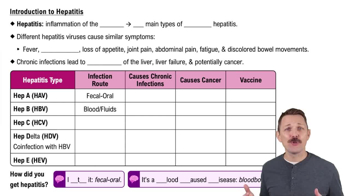
Introduction to Hepatitis
200
views
6
rank
Terms in this set (15)
Hide definitions
What is hepatitis?
Hepatitis is inflammation of the liver, often caused by viral infections.
What are the five main types of viral hepatitis?
The five main types are hepatitis A, B, C, D (delta), and E.
What symptom is characterized by yellowing of the skin and eyes in hepatitis patients?
Jaundice is the yellowing of the skin and eyes, caused by a buildup of bilirubin due to liver dysfunction.
Which hepatitis viruses are transmitted via the fecal-oral route?
Hepatitis A and E are transmitted via the fecal-oral route.
How are hepatitis B, C, and D transmitted?
Hepatitis B, C, and D are transmitted through blood and bodily fluids.
Which hepatitis virus requires co-infection with another hepatitis virus to replicate?
Hepatitis D (delta) requires co-infection with hepatitis B to replicate.
Which types of hepatitis can cause chronic infections?
Hepatitis B, C, and D can cause chronic infections.
What serious complications can chronic hepatitis infections lead to?
Chronic hepatitis can lead to cirrhosis, liver failure, and hepatocellular carcinoma (liver cancer).
Is there a vaccine available for hepatitis A and B?
Yes, vaccines are available for both hepatitis A and B.
Can hepatitis C be prevented with a vaccine?
No, there is no vaccine for hepatitis C, but it can be treated and cured with antivirals.
Why is hepatitis D considered a satellite virus?
Hepatitis D is a satellite virus because it cannot replicate without the presence of hepatitis B virus.
Which hepatitis viruses are not typically associated with chronic infection?
Hepatitis A and E are not typically associated with chronic infection.
What is a common way to remember which hepatitis viruses are fecal-oral transmitted?
Remember 'A and E in ate'—hepatitis A and E are transmitted via the fecal-oral route.
What is the relationship between chronic hepatitis infection and cancer risk?
Chronic hepatitis infections increase the risk of developing liver cancer.
How can vaccination against hepatitis B indirectly protect against hepatitis D?
Vaccination against hepatitis B prevents hepatitis D infection because hepatitis D requires hepatitis B to infect and replicate.
 BackBack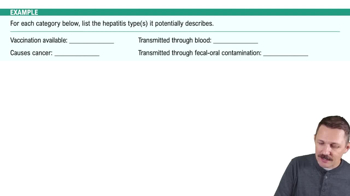
 02:05
02:05