Skip to main content
Microbiology
My Course
Learn
Exam Prep
AI Tutor
Study Guides
Textbook Solutions
Flashcards
Explore
Try the app
My Course
Learn
Exam Prep
AI Tutor
Study Guides
Textbook Solutions
Flashcards
Explore
Try the app
Back
Horizontal Gene Transfer definitions
You can tap to flip the card.
Horizontal Gene Transfer
You can tap to flip the card.
👆
Horizontal Gene Transfer
Exchange of genetic material between unrelated organisms, rapidly introducing new traits and increasing diversity.
Track progress
Control buttons has been changed to "navigation" mode.
1/14
Related flashcards
Related practice
Recommended videos
Horizontal Gene Transfer quiz
Horizontal Gene Transfer
15 Terms
Horizontal Gene Transfer
16. Microbial Genetics
5 problems
Topic
Brendan
Bacterial Transformation
16. Microbial Genetics
5 problems
Topic
Nicole
16. Microbial Genetics - Part 1 of 2
9 topics
14 problems
Chapter
Monica
16. Microbial Genetics - Part 2 of 2
8 topics
13 problems
Chapter
Nicole
03:13
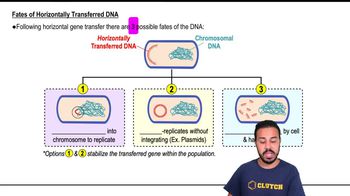
Fates of Horizontally Transferred DNA
1767
views
22
rank
04:42
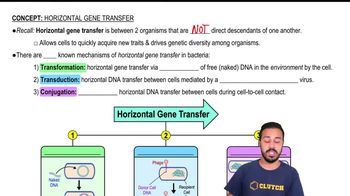
Horizontal Gene Transfer
2580
views
28
rank
02:52
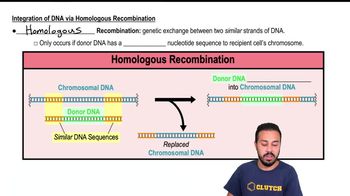
Integration of DNA via Homologous Recombination
1821
views
13
rank
Terms in this set (14)
Hide definitions
Horizontal Gene Transfer
Exchange of genetic material between unrelated organisms, rapidly introducing new traits and increasing diversity.
Transformation
Acquisition of free or naked DNA from the environment by a cell, leading to genetic change.
Transduction
Transfer of DNA between cells mediated by a bacteriophage, a virus that infects bacteria.
Conjugation
Direct transfer of genetic material between neighboring cells through physical contact.
Bacteriophage
Virus specialized in infecting bacteria, often facilitating gene transfer between cells.
Plasmid
Small, circular, extra-chromosomal DNA molecule capable of independent replication within a cell.
Chromosomal DNA
Primary genetic material of a cell, containing essential genes and serving as the main DNA repository.
Donor DNA
Genetic material originating from one organism and introduced into another during gene transfer.
Recipient Cell
Organism or cell that receives genetic material from another source during gene exchange.
Homologous Recombination
Genetic exchange process where similar DNA sequences enable integration of new genetic material.
Genetic Diversity
Variation in genetic traits within a population, often increased by gene exchange mechanisms.
Integration
Incorporation of foreign DNA into the host chromosome, allowing stable inheritance.
Self-Replication
Ability of a DNA molecule, such as a plasmid, to duplicate independently of the host chromosome.
Degradation
Breakdown of foreign DNA into fragments, resulting in no genetic effect on the host cell.
 BackBack
 03:13
03:13