Importance of Microorganisms quiz #1 Flashcards

Importance of Microorganisms quiz #1
Control buttons has been changed to "navigation" mode.
1/25
  • Which organisms contribute most to the decomposition of dead organisms?
    Microorganisms, such as bacteria and fungi, are the primary contributors to the decomposition of dead organisms.
  • Which are the most common microbes on Earth?
    Bacteria are the most common microbes on Earth.
  • What approximate percent of all bacteria are harmless and can even be beneficial to humans?
    About 99% of all bacteria are harmless and many are beneficial to humans.
  • Why are efforts made to identify unknown bacteria?
    Efforts are made to identify unknown bacteria to understand their roles in health, disease, and environmental processes.
  • Which of the following is a way in which bacteria help the environment?
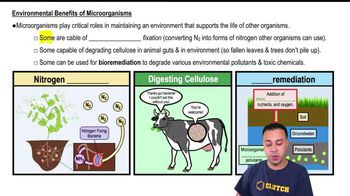
    Bacteria help the environment by performing nitrogen fixation, cellulose degradation, and bioremediation.
  • Which of the following does not indicate microbe involvement in energy and nutrient flow?
    Processes that do not involve decomposition, nitrogen fixation, or bioremediation do not indicate microbe involvement in energy and nutrient flow.
  • Bacteria that catabolize aromatic molecules are important for which of the following?
    Bacteria that catabolize aromatic molecules are important for bioremediation of environmental pollutants.
  • How might microorganisms be spread?
    Microorganisms can be spread through direct contact, contaminated surfaces, water, air, and food.
  • Which of the following is a consequence of water polluted by human sewage?
    Water polluted by human sewage can lead to the spread of disease-causing microorganisms.
  • What could happen if a pedicure bath is not properly cleaned?
    If a pedicure bath is not properly cleaned, harmful microorganisms can grow and cause infections.
  • Who uses microbiology?
    Microbiology is used by scientists, healthcare professionals, food producers, environmentalists, and researchers.
  • How does the release of carbon dioxide by microorganisms benefit plant life?
    The release of carbon dioxide by microorganisms benefits plant life by providing a source of carbon for photosynthesis.
  • Why are some scientists studying the bacteria that live in the guts of termites?
    Scientists study termite gut bacteria to understand cellulose degradation and its environmental impact.
  • More than half of our antibiotics are derived from which source?
    More than half of our antibiotics are derived from microorganisms, especially molds and bacteria.
  • Some molds are beneficial and used in the production of antibiotics. True or False?
    True. Some molds are beneficial and used in the production of antibiotics.
  • Microbes are useful research tools because
    Microbes are useful research tools because they share fundamental metabolic and genetic features with complex organisms and are easy and inexpensive to grow.
  • Microbes are not responsible for __________.
    Microbes are not responsible for processes unrelated to decomposition, nutrient cycling, or disease, such as photosynthesis in plants.
  • The Jungle, by Upton Sinclair, exposed unsafe and unsanitary practices in the ___ industry.
    The Jungle, by Upton Sinclair, exposed unsafe and unsanitary practices in the meatpacking industry.
  • The presence or growth of microorganisms is a type of
    The presence or growth of microorganisms is a type of biological hazard.
  • Common commercial benefits of microorganisms include synthesis of
    Common commercial benefits of microorganisms include synthesis of antibiotics, food products, biofuels, dietary supplements, insecticides, and plastics.
  • A healthy gut microbiota profoundly influences
    A healthy gut microbiota profoundly influences human health by aiding digestion and protecting against pathogens.
  • What approximate percent of all bacteria are harmless?
    Approximately 99% of all bacteria are harmless.
  • Bacteria and other microbes can be used to clean up
    Bacteria and other microbes can be used to clean up environmental pollutants through bioremediation.
  • The presence or growth of microorganisms is a type of what hazard?
    The presence or growth of microorganisms is a type of biological hazard.
  • A human plus all of its resident microbiota is a(n)
    A human plus all of its resident microbiota is a holobiont.