Back

Interferon Response definitions

Control buttons has been changed to "navigation" mode.
1/15
  • Interferon

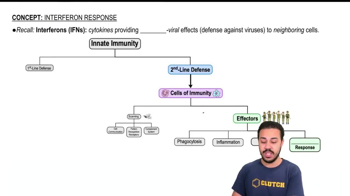
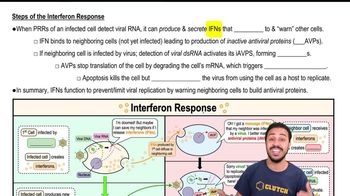
    A cytokine released by virus-infected cells that signals neighboring cells to initiate antiviral defenses.
  • Cytokine

    A chemical messenger that mediates communication between cells, especially during immune responses.
  • Innate Immunity

    The body's immediate, non-specific defense system that acts as a second line of defense against pathogens.
  • Pattern Recognition Receptor

    A sensor on cells that detects viral RNA, triggering immune signaling and interferon production.
  • Viral RNA

    Genetic material from viruses recognized by host cells as a sign of infection.
  • Inactive Antiviral Protein

    A molecule produced in response to interferons, remaining dormant until viral RNA is detected.
  • Active Antiviral Protein

    A molecule that, once activated by viral RNA, degrades cellular mRNA and initiates apoptosis.
  • Apoptosis

    A programmed cell death process that eliminates infected cells, blocking viral replication.
  • Antiviral Effect

    A protective outcome where cells resist viral replication due to interferon-induced changes.
  • Second Line of Defense

    A phase of innate immunity involving cellular responses like interferon signaling to contain infections.
  • Viral Replication

    The process by which viruses multiply within host cells, often targeted by immune defenses.
  • Effector Action

    A direct immune response, such as interferon release, that acts to neutralize pathogens.
  • mRNA Degradation

    The breakdown of messenger RNA in cells, preventing protein synthesis and viral propagation.
  • Host Cell

    A living cell that can be infected and used by viruses for replication.
  • Diffusion

    The movement of interferon molecules from infected cells to neighboring cells to spread warning signals.