Back

Introduction to Archaea definitions

Control buttons has been changed to "navigation" mode.
1/14
  • Archaea

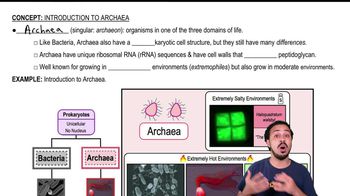
    One of the three domains of life, consisting of prokaryotes distinct from bacteria and eukarya, often found in extreme environments.
  • Prokaryote

    A unicellular organism lacking a nucleus, including both archaea and bacteria, but with significant differences between the two.
  • Domain

    The highest taxonomic rank in biological classification, grouping life into bacteria, archaea, and eukarya.
  • Bacteria

    A domain of prokaryotic organisms, distinct from archaea, characterized by cell walls containing peptidoglycan.
  • Eukarya

    A domain of life containing organisms with cells that have a nucleus, differing from both bacteria and archaea.
  • Ribosomal RNA

    A molecular component of ribosomes with unique sequences in archaea, distinguishing them from bacteria and eukarya.
  • Peptidoglycan

    A molecule forming the cell wall in bacteria, absent in archaea, serving as a key difference between these domains.
  • Cell Wall

    A structural layer surrounding some cells; in archaea, it lacks peptidoglycan, unlike in bacteria.
  • Extremophile

    An organism capable of thriving in extreme conditions, such as high salinity, temperature, or pressure, commonly found among archaea.
  • Microbiota

    The community of microorganisms, including archaea, that inhabit environments like soil or the human body.
  • Haloquadratum walsbyi

    A square-shaped archaeon known for thriving in highly salty environments, earning the nickname 'salt square.'
  • Pyrolobus fumari

    An archaeon adapted to extremely hot environments, often referred to as the 'fire lobe of the chimney.'
  • Pyrococcus furiosus

    A heat-loving archaeon, nicknamed the 'furious fireball,' capable of surviving in very high temperatures.
  • Thermococcus gammatolerans

    A hyperthermophilic archaeon, known as the 'ball of fire,' able to withstand extreme heat.