Back

Introduction to Avoiding Host Defense Mechanisms quiz

Control buttons has been changed to "navigation" mode.
1/15
  • What is the main topic introduced in the lesson video?

    The main topic is how pathogens avoid host defense mechanisms.
  • Why have pathogens evolved mechanisms to avoid host defenses?

    Pathogens have evolved these mechanisms to evade the host's immune system and cause disease.
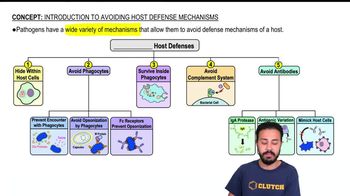
  • What does the lesson map titled 'Avoiding Host Defenses' represent?

    It represents the different strategies pathogens use to evade host defenses, serving as a guide for the course content.
  • What is one way pathogens can avoid host defenses by interacting with host cells?

    Pathogens can hide within host cells to avoid detection and destruction by the immune system.
  • How do pathogens prevent encounters with phagocytes?

    They use various strategies to avoid being detected or approached by phagocytes.
  • What is opsonization and how do pathogens avoid it?

    Opsonization is the process where pathogens are marked for destruction by phagocytes; pathogens can avoid it by using capsules or Fc receptors.
  • What role do capsules play in avoiding host defenses?

    Capsules help pathogens avoid opsonization and subsequent phagocytosis.
  • How do Fc receptors help pathogens evade the immune system?

    Fc receptors can bind antibodies in a way that prevents phagocytes from recognizing and destroying the pathogen.
  • What is one strategy pathogens use to survive inside phagocytes?

    Pathogens can survive inside phagocytes by resisting the killing mechanisms within these immune cells.
  • How do pathogens avoid the complement system?

    They use specific mechanisms to prevent activation or effects of the complement system, which is part of the immune response.
  • What is the function of IgA proteases in immune evasion?

    IgA proteases break down IgA antibodies, helping pathogens evade immune detection at mucosal surfaces.
  • How does antigenic variation help pathogens avoid host defenses?

    Antigenic variation allows pathogens to change their surface proteins, making it harder for the immune system to recognize them.
  • What does it mean for a pathogen to mimic host cells?

    Mimicking host cells means the pathogen displays molecules similar to the host's own cells, helping it avoid immune detection.
  • What will the next lesson video focus on according to the introduction?

    The next lesson will discuss in detail how pathogens hide within host cells.
  • Why is the lesson map useful for students?

    The lesson map helps students track their progress and understand the sequence of topics covered in the course.