Introduction to Bacterial Cell Walls quiz #1 Flashcards

Introduction to Bacterial Cell Walls quiz #1
Control buttons has been changed to "navigation" mode.
1/18
  • Which of the following may be a component of bacterial cell walls?
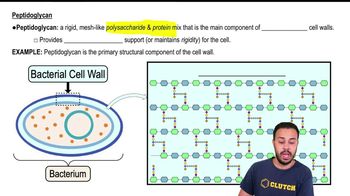
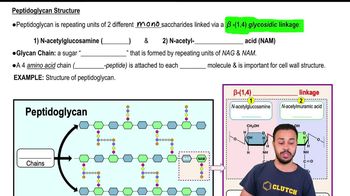
    Peptidoglycan is a primary component of bacterial cell walls.
  • What is true of bacterial mRNAs?
    Bacterial mRNAs are typically short-lived and are translated while being transcribed, but this is not directly related to bacterial cell walls.
  • Which of the following statements accurately describes bacterial cell walls?
    Bacterial cell walls are semi-rigid structures made predominantly of peptidoglycan, providing protection against internal water pressure.
  • Which of the following drugs specifically targets cell walls that contain mycolic acid?
    Drugs like isoniazid specifically target cell walls containing mycolic acid, which are found in certain bacteria such as Mycobacterium.
  • What structures are used by bacteriophages to attach to host cell receptors?
    Bacteriophages use tail fibers to attach to host cell receptors.
  • Why are white colonies desirable (rather than blue colonies) in bacterial cloning experiments?
    White colonies indicate successful insertion of foreign DNA, disrupting the lacZ gene, while blue colonies do not contain the insert.
  • Peptidoglycan is a unique macromolecule found in bacterial cell walls. What is its function?
    Peptidoglycan provides rigidity and structural support, protecting bacteria from rupturing due to internal water pressure.
  • What is a small, circumscribed lesion containing pus called?
    A small, circumscribed lesion containing pus is called a pustule.
  • What is a small circumscribed lesion containing pus?
    A small circumscribed lesion containing pus is called a pustule.
  • Most bacteria have rigid cell walls that contain a unique compound called what?
    Most bacteria have rigid cell walls that contain a unique compound called peptidoglycan.
  • Identify the area between the cell wall and cell membrane in gram-positive bacteria.
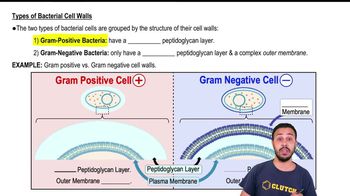
    The area between the cell wall and cell membrane in gram-positive bacteria is called the periplasmic space.
  • In the figure, which diagram of a cell wall contains teichoic acids?
    The diagram of a gram-positive cell wall contains teichoic acids.
  • In the figure, which diagram of a cell wall has a structure that protects against osmotic lysis?
    Both gram-positive and gram-negative cell wall diagrams show peptidoglycan, which protects against osmotic lysis.
  • Which type of bacterial enzyme helps spread Streptococcus pyogenes by digesting blood clots?
    Streptokinase is the bacterial enzyme that helps spread Streptococcus pyogenes by digesting blood clots.
  • Which of the following prevents the rupture of bacterial cells by internal osmotic pressure?
    The peptidoglycan layer prevents the rupture of bacterial cells by internal osmotic pressure.
  • In some bacterial cells, a whiplike extension called a ______ is used for movement.
    In some bacterial cells, a whiplike extension called a flagellum is used for movement.
  • The cell wall in bacteria is primarily composed of what?
    The cell wall in bacteria is primarily composed of peptidoglycan.
  • What part of bacteria helps it stick to surfaces?
    Fimbriae help bacteria stick to surfaces.