Most bacterial plasmids carry an origin of replication and at most a few non-essential genes. What types of genes are commonly found on plasmids?
Most bacterial plasmids carry an origin of replication and at most a few non-essential genes, such as those for antibiotic resistance or other traits not required for cell survival.
What is the structural form of most bacterial plasmids?
Most bacterial plasmids are small, circular, double-stranded DNA molecules.
How do plasmids replicate within bacterial cells?
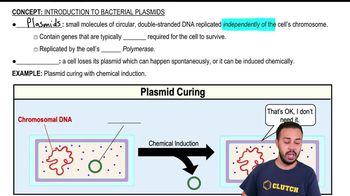
Plasmids replicate independently of the bacterial chromosome using the cell's DNA polymerase.
What is plasmid curing and how can it occur?
Plasmid curing is the process by which a cell loses its plasmid, which can happen spontaneously or be induced chemically.
After plasmid curing, what happens to the bacterial cell if the plasmid contained only non-essential genes?
The bacterial cell can survive without the plasmid if it contained only non-essential genes.
What is an episome in the context of bacterial genetics?
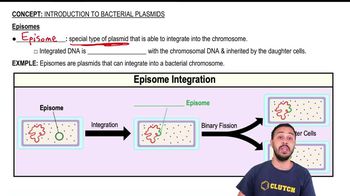
An episome is a type of plasmid that can integrate into the bacterial chromosome.
How are episomes inherited by daughter cells during cell division?
Once integrated into the chromosome, episomes are replicated and inherited by daughter cells during binary fission.
What enzyme is responsible for replicating plasmid DNA in bacteria?
The cell's DNA polymerase is responsible for replicating plasmid DNA.
How can the integration of an episome into the bacterial chromosome be visualized?
Integration can be visualized in diagrams showing the episome embedded within the chromosomal DNA.
What happens to the genes on an episome after it integrates into the bacterial chromosome?
The genes on the episome are replicated along with the chromosomal DNA and passed to daughter cells.