Introduction to Aerobic Cellular Respiration quiz #1 Flashcards

Introduction to Aerobic Cellular Respiration quiz #1
Control buttons has been changed to "navigation" mode.
1/10
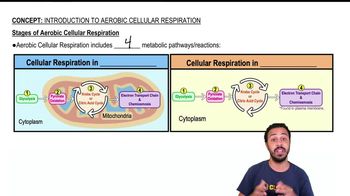
  • What are the main stages of aerobic cellular respiration, and where do they occur in eukaryotic cells?
    The main stages of aerobic cellular respiration are glycolysis, pyruvate oxidation, the Krebs cycle (citric acid cycle), and the electron transport chain with chemiosmosis. In eukaryotic cells, glycolysis occurs in the cytoplasm, while the other stages take place in the mitochondria.
  • Anaerobic bacteria may use ________ as the final electron acceptor during anaerobic respiration.
    Anaerobic bacteria may use substances such as nitrogen compounds (e.g., nitrate) or sulfur compounds (e.g., sulfate) as the final electron acceptor during anaerobic respiration.
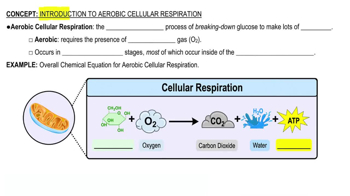
  • What is the main purpose of aerobic cellular respiration in cells?
    The main purpose is to produce large amounts of ATP, which provides energy for various cellular processes.
  • Which chemical formula represents glucose, the primary fuel for aerobic cellular respiration?
    The chemical formula for glucose is C6H12O6.
  • In aerobic cellular respiration, which molecule is oxidized and which is reduced?
    Glucose is oxidized (loses electrons), while oxygen is reduced (gains electrons).
  • How many ATP molecules are typically produced from one molecule of glucose during aerobic cellular respiration?
    Aerobic cellular respiration typically produces between 30 and 38 ATP molecules per glucose molecule.
  • What mnemonic can help you remember the order of the four stages of aerobic cellular respiration?
    The mnemonic 'Giant pandas killed Einstein' helps remember glycolysis, pyruvate oxidation, Krebs cycle, and electron transport chain.
  • Where does glycolysis occur in eukaryotic cells?
    Glycolysis occurs in the cytoplasm of eukaryotic cells.
  • What are two alternative pathways to glycolysis mentioned in the lesson?
    The pentose phosphate pathway (PPP) and the Entner-Doudoroff pathway (EDP) are alternatives to glycolysis.
  • Which stage of aerobic cellular respiration does not directly generate ATP?
    Pyruvate oxidation does not directly generate ATP.