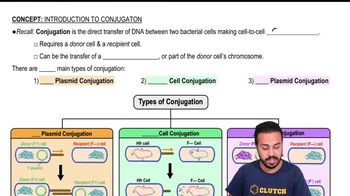
Conjugation is the direct transfer of DNA between two bacterial cells through cell-to-cell contact.
How many main types of conjugation are there?
There are three main types of conjugation: F+ plasmid conjugation, HFR cell conjugation, and F' (prime) plasmid conjugation.
What is required for conjugation to occur between bacterial cells?
Conjugation requires a donor cell to provide DNA and a recipient cell to receive the DNA.
What can be transferred during conjugation?
Either a plasmid or part of the donor cell's chromosomal DNA can be transferred during conjugation.
What is transferred in F+ plasmid conjugation?
The entire F plasmid is transferred from the donor cell to the recipient cell in F+ plasmid conjugation.
What is transferred in HFR cell conjugation?
Only part of the integrated F plasmid and some of the donor cell's chromosomal DNA are transferred in HFR cell conjugation.
What is transferred in F' (prime) plasmid conjugation?
The entire F' plasmid, which includes integrated donor DNA, is transferred to the recipient cell.
Which type of conjugation involves the transfer of chromosomal DNA?
HFR cell conjugation involves the transfer of some chromosomal DNA from the donor cell.
What does the F' plasmid contain that is unique?
The F' plasmid contains integrated donor DNA in addition to the plasmid DNA.
Will the details of each conjugation type be covered in this video?
No, the details of each conjugation type will be covered in separate, future videos.
What is the role of the donor cell in conjugation?
The donor cell provides the DNA that will be transferred to the recipient cell.
What is the role of the recipient cell in conjugation?
The recipient cell receives DNA from the donor cell during conjugation.
Is cell-to-cell contact necessary for conjugation?
Yes, direct cell-to-cell contact is necessary for conjugation to occur.
Which type of conjugation transfers the entire F plasmid without chromosomal DNA?
F+ plasmid conjugation transfers the entire F plasmid without chromosomal DNA.
What is the main difference between HFR and F' conjugation?
HFR conjugation transfers part of the integrated F plasmid and chromosomal DNA, while F' conjugation transfers the entire F' plasmid with integrated donor DNA.
 Back
Back
 04:21
04:21