Introduction to Controlling Microbial Growth quiz #1 Flashcards

Introduction to Controlling Microbial Growth quiz #1
1 student found this helpful
Control buttons has been changed to "navigation" mode.
1/24
  • Which of the following is an example of microbial control?
    Examples of microbial control include washing hands, sterilizing surgical equipment, pasteurizing milk, and disinfecting water.
  • Which practice can help prevent cross-contamination?
    Practices such as using aseptic technique, wearing gloves, and cleaning surfaces help prevent cross-contamination.
  • To be an effective disinfectant, what must a chemical do?
    An effective disinfectant must eliminate most pathogens from a surface, though some resistant microbes may remain.
  • When should sterile gloves be worn?
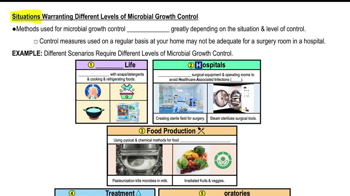
    Sterile gloves should be worn during procedures that require a sterile field, such as surgery or handling sterile equipment in laboratories.
  • What is the second level of infection control according to the microbial control hierarchy?
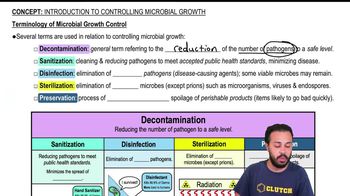
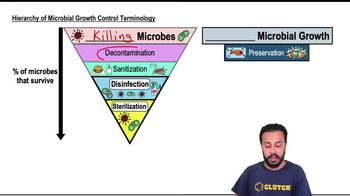
    The second level of infection control is sanitization, which reduces pathogens to meet public health standards.
  • What piece of equipment is often used to sterilize objects in hospitals and laboratories?
    An autoclave is often used to sterilize objects in hospitals and laboratories.
  • The easiest microbial forms to kill or inhibit are:
    The easiest microbial forms to kill or inhibit are vegetative cells, which are less resistant than endospores.
  • Which is correct regarding the rate of microbial death during control procedures?
    The rate of microbial death depends on the method used, the type of microbe, and environmental conditions.
  • What is the process of bombardment with radiation at the cellular level to control microbes called?
    This process is called irradiation.
  • What is the destruction of most microbes using chemicals on a living surface such as the skin called?
    This process is called disinfection.
  • Check all the ways heat can be used to control microbes.
    Heat can be used as moist heat (e.g., autoclaving, boiling), dry heat (e.g., incineration, ovens), and pasteurization.
  • Microbial control methods that kill which type of microbe are able to sterilize?
    Methods that kill endospores are able to sterilize.
  • Does sterilization kill endospores?
    Yes, sterilization kills endospores.
  • Which best describes how heavy metals can control microbial growth?
    Heavy metals can inhibit microbial growth by disrupting cellular processes and proteins.
  • Does autoclaving kill endospores?
    Yes, autoclaving kills endospores.
  • You can kill most bacteria in food by what method?
    You can kill most bacteria in food by cooking or pasteurization.
  • The most efficient type of dry heat sterilizer is:
    The most efficient type of dry heat sterilizer is an oven.
  • Germicidal chemicals are used for what purpose?
    Germicidal chemicals are used to kill or inhibit microbes on surfaces or objects.
  • Microbial control methods are referred to as what?
    Microbial control methods are referred to as physical, chemical, or combination methods.
  • To destroy or kill certain microbes on nonporous surfaces is referred to as what?
    This is referred to as disinfection.
  • What preservation technique attempts to remove moisture?
    Drying or dehydration is a preservation technique that removes moisture.
  • Some disinfectants may be sprayed on the instruments, tools, or equipment to be disinfected. What is the purpose of this practice?
    Spraying disinfectants on instruments helps eliminate most pathogens and reduce the risk of infection.
  • What activity would best prevent contamination in a laboratory setting?
    Using aseptic technique and wearing personal protective equipment best prevent contamination.
  • Which method best ensures that pathogens are reduced to safe levels?
    Decontamination best ensures that pathogens are reduced to safe levels.