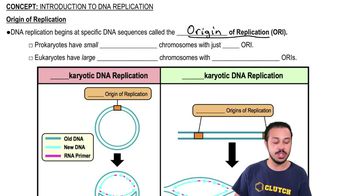
What is the main difference between prokaryotic and eukaryotic DNA replication origins?
Prokaryotes have a single origin of replication on their circular chromosome, while eukaryotes have multiple origins on their linear chromosomes.
What does semi-conservative DNA replication mean?
It means each parental DNA strand separates and serves as a template for a new complementary strand, resulting in two identical DNA molecules.
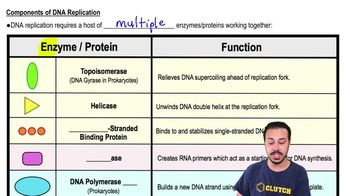
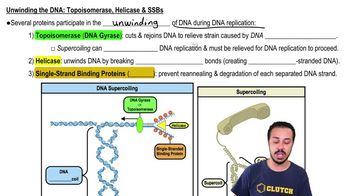
What is the function of topoisomerase (DNA gyrase in prokaryotes) during DNA replication?
Topoisomerase relieves DNA supercoiling ahead of the replication fork by cutting and rejoining DNA strands.
What role does helicase play in DNA replication?
Helicase unwinds the DNA double helix by breaking hydrogen bonds between the two DNA strands at the replication fork.
What is the function of single-stranded binding proteins (SSBs) in DNA replication?
SSBs bind to and stabilize single-stranded DNA, preventing reannealing and degradation of the separated strands.
What does primase do during DNA replication?
Primase synthesizes short RNA primers that provide a starting point for DNA synthesis.
Which enzyme is primarily responsible for synthesizing new DNA strands in prokaryotes?
DNA Polymerase III is the main enzyme that synthesizes new DNA strands using the old strand as a template.
What is the function of DNA Polymerase I in prokaryotic DNA replication?
DNA Polymerase I replaces RNA primers with DNA nucleotides.
What does DNA ligase do during DNA replication?
DNA ligase covalently joins Okazaki fragments on the lagging strand to create a continuous DNA strand.
Where does DNA replication begin on a DNA molecule?
DNA replication begins at a specific DNA sequence called the origin of replication (ori).
What is a replication fork?
A replication fork is a Y-shaped region at the end of the unwound DNA bubble where DNA replication actively occurs.
How does DNA replication proceed from the origin of replication?
DNA replication proceeds bidirectionally from the origin, meaning it moves in both directions at each replication fork.
Why must DNA supercoiling be relieved during replication?
Supercoiling creates strain that can inhibit DNA replication, so it must be relieved for replication to proceed normally.
What prevents the separated DNA strands from reannealing during replication?
Single-stranded binding proteins bind to the separated strands, preventing them from reannealing.
Why is the process of DNA replication considered fundamentally similar in prokaryotes and eukaryotes?
Because both use semi-conservative replication and involve similar enzymes and proteins, despite differences in chromosome structure and number of origins.
 Back
Back
 05:10
05:10