Back

Introduction to Energy definitions

Control buttons has been changed to "navigation" mode.
1/15
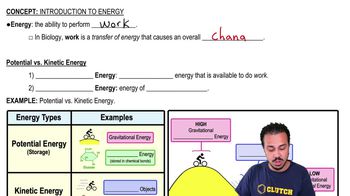
  • Energy

    Ability to cause an overall change in a living system, enabling biological processes and transformations.
  • Work

    Transfer of energy resulting in an overall change within a biological context, not related to academic assignments.
  • Potential Energy

    Stored form capable of being used to cause change, such as energy held by position or chemical bonds.
  • Kinetic Energy

    Form associated with motion, present in moving objects or during muscle contractions.
  • Gravitational Potential Energy

    Stored form due to an object's position relative to gravity, such as a biker at the top of a hill.
  • Chemical Potential Energy

    Stored form within chemical bonds, exemplified by molecules like glucose in biological systems.
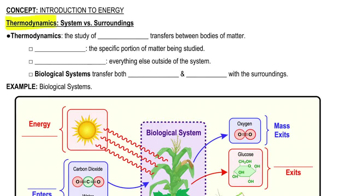
  • Thermodynamics

    Study of energy transfers between bodies of matter, focusing on how energy moves and changes form.
  • System

    Specific portion of matter under study, which can range from a single reaction to an entire organism.
  • Surroundings

    Everything external to the system, encompassing all matter and energy outside the area of focus.
  • Biological System

    Living entity capable of exchanging both energy and mass with its environment, such as a plant.
  • Photosynthesis

    Process where solar energy, carbon dioxide, and water are converted into glucose and oxygen in plants.
  • Glucose

    Most abundant sugar, serving as a primary example of stored chemical potential energy in cells.
  • Oxygen

    Gaseous product released from biological systems during processes like photosynthesis.
  • Carbon Dioxide

    Gaseous molecule entering biological systems, used as a raw material in energy conversion processes.
  • Solar Energy

    Form of energy from sunlight, utilized by plants to drive the conversion of inorganic molecules into organic compounds.