Back

Introduction to Energy quiz

Control buttons has been changed to "navigation" mode.
1/15
  • What is the biological definition of energy?

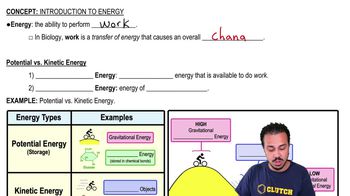
    Energy is the ability to perform work, causing an overall change in a living system.
  • What are the two main types of energy discussed in biology?

    The two main types are potential energy (stored energy) and kinetic energy (energy of motion).
  • What is potential energy?

    Potential energy is stored energy that has the potential to do work or cause a change.
  • Give an example of gravitational potential energy.

    A biker at the top of a hill has high gravitational potential energy.
  • What is chemical potential energy and give an example?

    Chemical potential energy is energy stored in chemical bonds, such as in glucose molecules.
  • What is kinetic energy?

    Kinetic energy is the energy of motion, possessed by any moving object.
  • Provide two examples of kinetic energy in biological systems.

    Examples include a biker coasting downhill and muscle contractions.
  • How does potential energy convert to kinetic energy in the example of a biker?

    When the biker starts moving downhill, their gravitational potential energy is converted into kinetic energy.
  • What happens to the gravitational potential energy of a biker at the bottom of a hill?

    The biker has low gravitational potential energy at the bottom of the hill.
  • What is thermodynamics in the context of biology?

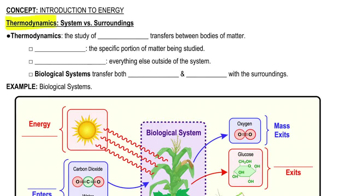
    Thermodynamics is the study of energy transfers between different bodies of matter.
  • How is a 'system' defined in thermodynamics?

    A system is the specific portion of matter being studied, which can range from an entire organism to a single reaction.
  • What are 'surroundings' in thermodynamics?

    Surroundings are everything external to the system, essentially everything outside the system being studied.
  • How do biological systems interact with their surroundings?

    Biological systems can transfer both energy and mass with their surroundings.
  • Describe the energy and mass transfers that occur during photosynthesis in a plant.

    Solar energy, carbon dioxide, and water enter the plant (system), and glucose and oxygen exit, demonstrating energy and mass transfer.
  • Why is glucose considered a form of chemical potential energy?

    Glucose contains chemical bonds that store energy, making it a common form of chemical potential energy.