Microbiology
My Course
Learn
Exam Prep
AI Tutor
Study Guides
Textbook Solutions
Flashcards
Explore
My Course
Learn
Exam Prep
AI Tutor
Study Guides
Textbook Solutions
Flashcards
Explore
Back
Introduction to Eukarya definitions
You can tap to flip the card.
Define:
Eukarya
You can tap to
flip the card.
👆
Eukarya
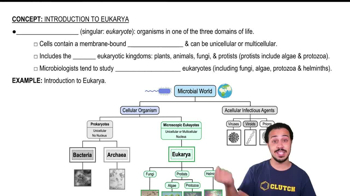
Domain of life containing organisms with membrane-bound nuclei, including plants, animals, fungi, and protists.
Track progress
Control buttons has been changed to "navigation" mode.
1/15
Related flashcards
Related practice
Recommended videos
Guided course
03:28
Introduction to Eukarya
Jason
5307
views
113
rank
Guided course
02:49
Fungi
Jason
4541
views
88
rank
Guided course
02:54
Protists:Algae
Jason
4200
views
76
rank
Terms in this set (15)
Hide definitions
Eukarya
Domain of life containing organisms with membrane-bound nuclei, including plants, animals, fungi, and protists.
Eukaryote
Organism with cells that possess a membrane-bound nucleus and can be unicellular or multicellular.
Membrane-bound nucleus
Cellular structure surrounded by a lipid bilayer, housing genetic material in eukaryotic cells.
Fungi
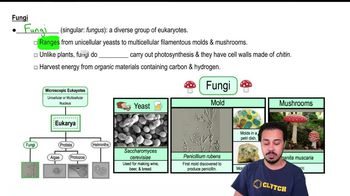
Diverse group of eukaryotes, ranging from yeasts to mushrooms, with chitin cell walls and no photosynthesis.
Chitin
Polysaccharide forming the rigid cell walls of fungi, distinguishing them from plants.
Algae
Photosynthetic eukaryotes, often called plant-like protists, with cellulose cell walls, found in moist habitats.
Cellulose
Polysaccharide composing the cell walls of algae and plants, providing structural support.
Protozoa
Unicellular, animal-like protists lacking cell walls, motile, and ingesting organic material.
Helminths
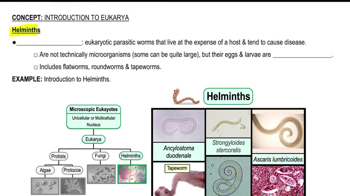
Parasitic eukaryotic worms, including flatworms and roundworms, with microscopic eggs and larvae.
Unicellular organism
Living entity composed of a single cell, characteristic of many microscopic eukaryotes.
Multicellular organism
Living entity made up of multiple cells, seen in some fungi, algae, and helminths.
Organic material
Substance containing carbon and hydrogen, serving as an energy source for fungi and protozoa.
Photosynthesis
Process by which certain eukaryotes, like algae, convert light energy into chemical energy.
Protists
Kingdom of eukaryotes including diverse groups such as algae and protozoa, often microscopic.
Microscopic eukaryote
Eukaryotic organism too small to be seen without a microscope, including fungi, algae, protozoa, and helminths.