Microbiology
My Course
Learn
Exam Prep
AI Tutor
Study Guides
Textbook Solutions
Flashcards
Explore
My Course
Learn
Exam Prep
AI Tutor
Study Guides
Textbook Solutions
Flashcards
Explore
Back
Introduction to Eukarya quiz #1
1 student found this helpful
You can tap to flip the card.
Define:
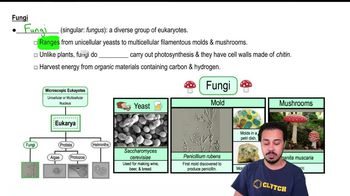
Which organisms lack chlorophyll and reproduce by means of spores?
You can tap to
flip the card.
👆
Which organisms lack chlorophyll and reproduce by means of spores?
Fungi lack chlorophyll and reproduce by means of spores.
Track progress
Control buttons has been changed to "navigation" mode.
1/10
Related flashcards
Related practice
Recommended videos
Guided course
03:28
Introduction to Eukarya
Jason
5345
views
116
rank
Guided course
02:49
Fungi
Jason
4579
views
91
rank
Guided course
02:54
Protists:Algae
Jason
4231
views
77
rank
Terms in this set (10)
Hide definitions
Which organisms lack chlorophyll and reproduce by means of spores?
Fungi lack chlorophyll and reproduce by means of spores.
What are flagellates in the context of microscopic eukaryotes?
Flagellates are protozoa that move using one or more whip-like structures called flagella.
Which feature distinguishes slime molds from fungi?
Slime molds lack cell walls made of chitin, which distinguishes them from fungi.
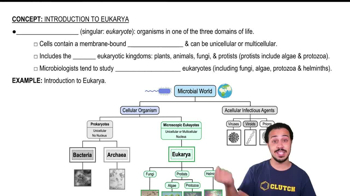
Which microorganisms contain organelles?
Eukaryotic microorganisms such as fungi, algae, protozoa, and helminths contain organelles.
What type of fungi are filamentous fungi?
Filamentous fungi are represented by molds, such as Penicillium species.
What is the main structural component of fungal cell walls?
The main structural component of fungal cell walls is chitin.
How do protozoa obtain their energy and nutrients?
Protozoa ingest organic materials as their source of energy and nutrients.
What distinguishes algae from fungi in terms of metabolism?
Algae are photosynthetic and perform photosynthesis, while fungi do not perform photosynthesis.
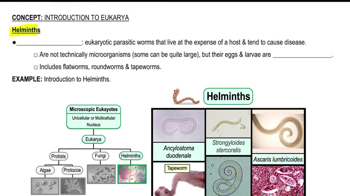
Why are helminths studied in microbiology even though they are not always microscopic?
Helminths are studied in microbiology because their eggs and larvae are microscopic and relevant to disease.
Which domain of life includes organisms with a membrane-bound nucleus?
The domain Eukarya includes organisms with a membrane-bound nucleus.