Back

Introduction to Eukaryotic Gene Regulation definitions

Control buttons has been changed to "navigation" mode.
1/15
  • Eukaryote

    An organism whose cells contain a nucleus and other organelles enclosed within membranes.
  • Gene Regulation

    A collection of mechanisms that control the timing, location, and amount of gene expression.
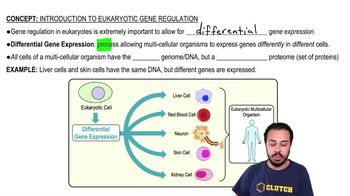
  • Differential Gene Expression

    A process enabling cells with identical DNA to produce distinct sets of proteins, resulting in diverse cell types.
  • Proteome

    The complete set of proteins expressed by a cell, which varies between cell types despite identical DNA.
  • Genome

    The entire set of genetic material present in a cell or organism, identical across all cell types.
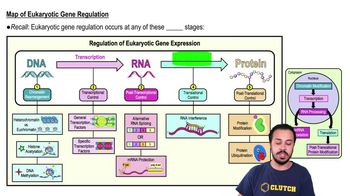
  • Chromatin Modification

    Chemical changes to DNA or histones that affect gene accessibility and expression without altering the DNA sequence.
  • Histone Acetylation

    A modification that loosens chromatin structure, making genes more accessible for transcription.
  • DNA Methylation

    A chemical addition to DNA that typically reduces gene expression by making DNA less accessible.
  • Transcriptional Control

    Regulation of gene expression at the stage where DNA is transcribed into RNA, often involving specific factors.
  • Transcription Factor

    A protein that binds to specific DNA sequences to enhance or inhibit the transcription of genes.
  • RNA Processing

    Modifications to RNA transcripts, such as splicing and capping, that prepare mRNA for translation.
  • mRNA Degradation

    The breakdown of messenger RNA molecules, controlling the amount of protein produced in the cell.
  • Translation

    The process where ribosomes synthesize proteins using mRNA as a template.
  • Post-Translational Modification

    Chemical changes to proteins after synthesis, affecting their function, location, or stability.
  • Cytoplasm

    The region of the cell outside the nucleus where translation and some gene regulation processes occur.