Introduction to Pathogenic Toxins quiz #1 Flashcards

Introduction to Pathogenic Toxins quiz #1
Control buttons has been changed to "navigation" mode.
1/10
  • Which statement about endotoxins is true?
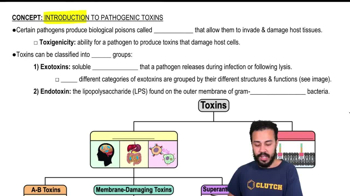
    Endotoxins specifically refer to lipopolysaccharide (LPS) found in the outer membrane of gram-negative bacteria.
  • An exotoxin that has the ability to kill or damage host cells is referred to as a cytotoxin.
    A cytotoxin is an exotoxin that can kill or damage host cells.
  • A pathogen can indirectly damage its host by overstimulating the host's immune system.
    Pathogens can cause indirect damage by triggering an excessive immune response, which can harm host tissues.
  • What does the term 'toxicogenicity' refer to in the context of pathogenic toxins?
    Toxicogenicity refers to a pathogen's ability to produce toxins that damage host cells.
  • How are exotoxins released by pathogens?
    Exotoxins are released by pathogens during infection or after the pathogen undergoes lysis.
  • What are the three main categories of exotoxins based on their structure and function?
    The three main categories of exotoxins are AB toxins, membrane-damaging toxins (including pore-forming toxins and phospholipases), and superantigens.
  • Where is lipopolysaccharide (LPS), the endotoxin, found in bacteria?
    Lipopolysaccharide (LPS) is found in the outer membrane of gram-negative bacteria.
  • What are membrane-damaging toxins, and what are two examples mentioned?
    Membrane-damaging toxins are exotoxins that disrupt host cell membranes; examples include pore-forming toxins and phospholipases.
  • How can pathogens cause harm without directly damaging host cells?
    Pathogens can cause harm by overstimulating the host's immune system, leading to unintended damage to host tissues.
  • Why is it important to study the different categories of exotoxins in microbiology?
    Studying the different categories of exotoxins helps us understand how pathogens invade and damage host tissues through various mechanisms.