Skip to main content
Microbiology
My Course
Learn
Exam Prep
AI Tutor
Study Guides
Textbook Solutions
Flashcards
Explore
Try the app
My Course
Learn
Exam Prep
AI Tutor
Study Guides
Textbook Solutions
Flashcards
Explore
Try the app
Back
Introduction to Hypersensitivites definitions
You can tap to flip the card.
Immune System
You can tap to flip the card.
👆
Immune System
A network of cells and molecules responsible for defending the body against pathogens, toxins, and abnormal cells.
Track progress
Control buttons has been changed to "navigation" mode.
1/15
Related flashcards
Related practice
Recommended videos
Introduction to Hypersensitivites quiz
Introduction to Hypersensitivites
15 Terms
Introduction to Hypersensitivites
27. Immunological Disorders
4 problems
Topic
Type I Hypersensitivities
27. Immunological Disorders
4 problems
Topic
27. Immunological Disorders - Part 1 of 2
4 topics
11 problems
Chapter
27. Immunological Disorders - Part 2 of 2
4 topics
6 problems
Chapter
05:35
Overview: Hypersensitivities & Sensitization
216
views
5
rank
02:03
Introduction to Immunological Disorders
245
views
2
rank
Terms in this set (15)
Hide definitions
Immune System
A network of cells and molecules responsible for defending the body against pathogens, toxins, and abnormal cells.
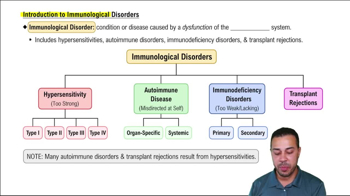
Immunological Disorder
A condition resulting from improper immune function, including overactivity, underactivity, or misdirection.
Hypersensitivity
An exaggerated, harmful immune response that occurs only after prior sensitization to an antigen.
Sensitization
The initial immune exposure to an antigen, priming the system for a stronger reaction upon later encounters.
Antigen
A substance recognized by the immune system as foreign, capable of triggering an immune response.
Antibody
A protein produced by B cells that binds specifically to antigens, playing a central role in immune defense.
Type I Hypersensitivity
A rapid, IgE-mediated allergic reaction to harmless substances like pollen or foods, often causing classic allergy symptoms.
Type II Hypersensitivity
A cytotoxic reaction where antibodies target cell surfaces, leading to cell destruction, as seen in transfusion reactions.
Type III Hypersensitivity
A response driven by immune complex formation and deposition, resulting in inflammation and tissue damage.
Type IV Hypersensitivity
A delayed immune reaction mediated by T cells, typically manifesting hours to days after antigen exposure.
Autoimmune Disease
A disorder where the immune system mistakenly targets the body's own cells and tissues.
Immunodeficiency
A state where the immune system's ability to fight infections is compromised or absent.
Transplant Rejection
An immune response against transplanted tissue or organs, often involving hypersensitivity mechanisms.
Immune Complex
A cluster formed when antibodies bind to antigens, which can deposit in tissues and trigger inflammation.
T Cell
A lymphocyte that orchestrates immune responses, especially in cell-mediated immunity and delayed hypersensitivity.
 BackBack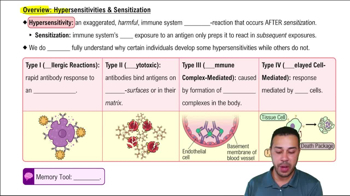
 05:35
05:35