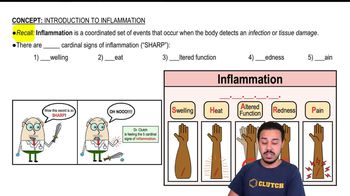
Four cardinal signs of inflammation are recognized. What are these signs?
The four cardinal signs of inflammation are redness, heat, swelling, and pain. A fifth sign, altered function, is also commonly included.
What does the acronym SHARP stand for in the context of inflammation?
SHARP stands for swelling, heat, altered function, redness, and pain, which are the five cardinal signs of inflammation.
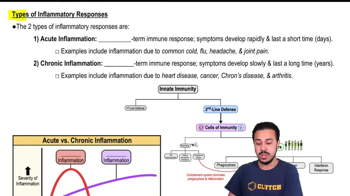
How do the symptoms of acute inflammation differ in onset and duration compared to chronic inflammation?
Acute inflammation symptoms develop rapidly and last only a few days, while chronic inflammation symptoms develop slowly and can persist for years.
Which type of immune cell is most abundant during acute inflammation?
Neutrophils are the most abundant immune cells at the site of acute inflammation.
What is the primary goal of acute inflammation?
The primary goal of acute inflammation is to quickly recruit immune cells to the site of infection or tissue damage.
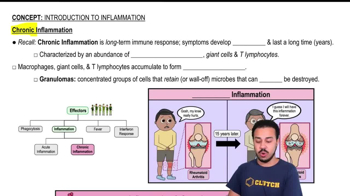
What types of cells are characteristic of chronic inflammation?
Chronic inflammation is characterized by the presence of macrophages, giant cells, and T lymphocytes.
What is a granuloma and when does it form?
A granuloma is a concentrated group of immune cells that forms during chronic inflammation to wall off microbes that cannot be easily destroyed.
Give two examples of conditions associated with chronic inflammation.
Heart disease and Crohn's disease are examples of conditions associated with chronic inflammation.
What is the difference in the immune cell response between acute and chronic inflammation?
Acute inflammation involves a rapid influx of neutrophils, while chronic inflammation involves macrophages, giant cells, and T lymphocytes.
How does the severity and duration of acute inflammation compare to chronic inflammation on a graph?
On a graph, acute inflammation shows a sharp increase in severity over a short time, while chronic inflammation shows a gradual, prolonged response over years.