Introduction to Innate Immunity quiz #1 Flashcards
Introduction to Innate Immunity quiz #1
You can tap to flip the card.
Control buttons has been changed to "navigation" mode.
1/32
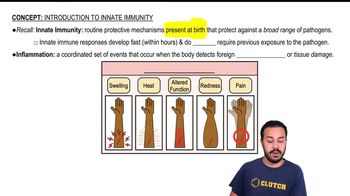
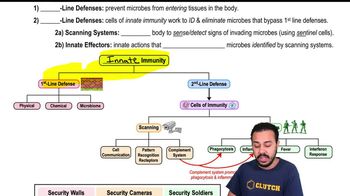
What is an example of a virulence factor that helps pathogens evade the immune system?A capsule is a virulence factor that helps pathogens evade the immune system by preventing phagocytosis.Which of the following is involved in non-specific (innate) immunity?Physical barriers, chemical barriers, and cells such as phagocytes are involved in non-specific (innate) immunity.Which of these is an example of an innate immune defense?Inflammation is an example of an innate immune defense.Which of the following acts as a mechanical barrier to pathogen entry into the body?The skin acts as a mechanical barrier to pathogen entry.Which of the following is another term for an immune reaction?An immune response is another term for an immune reaction.The innate immune system stimulates the adaptive immune system through which of the following mechanisms?The innate immune system stimulates the adaptive immune system through inflammation and the release of signaling molecules.What intrinsic factor serves as protection from invasion of microorganisms?The microbiome serves as an intrinsic factor protecting against invasion by microorganisms.Which of the following are true of pyrogens? (More than one option is correct.)Pyrogens are chemicals that induce fever and are part of the innate immune response.Which of the following are defenses of the urinary tract to prevent microbial infection?Physical barriers and flushing action of urine are defenses of the urinary tract.Which of the following is an outcome of complement activation?Complement activation can lead to phagocytosis and inflammation.Which external structure of microbes directly impacts the effectiveness of the host immune system?The capsule of microbes directly impacts the effectiveness of the host immune system.What are produced by the immune system to destroy, kill, or inactivate pathogens?Antimicrobial proteins and immune cells are produced to destroy, kill, or inactivate pathogens.The first line of defense of innate immunity includes ______.Physical barriers, chemical barriers, and the microbiome.Enhanced phagocytosis of a cell by the binding of a specific protein is called ________.Opsonization.The complement system ______ the inflammatory response.Promotes the inflammatory response.Foreign substances in the body that provoke an immune response are called:Antigens.Antimicrobial proteins are part of the ______ immune system.Innate immune system.The first line of cellular defense against pathogens are thePhagocytes.What term refers to any molecule that elicits an immune response?Antigen.The symptoms of an immune complex reaction are due toInflammation caused by immune complexes.Opsonization resulting from the complement cascade is ______.The enhanced phagocytosis of pathogens.Immunocompetence refers to ________.The ability of the immune system to recognize and respond to pathogens.The components of the second line of defense against microbes may be characterized asCells and proteins that identify and eliminate microbes.Interferons, complement, lysozyme, and lactoferrin are all examples ofAntimicrobial proteins of the innate immune system.Which of the following characteristics is associated with innate immunity?Rapid response and non-specific defense.Fever is initiated by chemicals called__________.Pyrogens.Specifically, interferons are ______.Proteins that help defend against viral infections.Lymphocytes secrete antibodies, coordinate action of other immune cells, and serve in immune memory. Which branch of immunity are they part of?Adaptive immunity.What is an overview of the immune response?The immune response involves recognition of pathogens, activation of defenses, and elimination of invaders.The body’s ability to destroy infectious agents that enter the body is called:Immunity.The membrane attack stage of the complement cascade involvesFormation of pores in pathogen membranes leading to cell lysis.Immunity acquired by contact with a disease organism is described as:Active immunity.