Back

Introduction to Membrane Transport definitions

Control buttons has been changed to "navigation" mode.
1/15
  • Biological Membrane

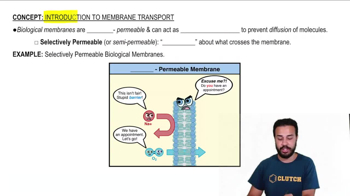
    A selectively permeable barrier that controls which molecules can enter or exit a cell based on specific properties.
  • Selective Permeability

    A property allowing only certain molecules to cross a membrane while restricting others, based on size, charge, and polarity.
  • Diffusion

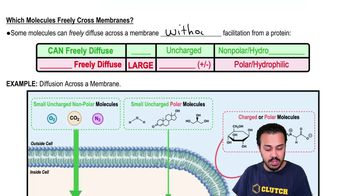
    The movement of molecules from an area of high concentration to low concentration, which may or may not require facilitation.
  • Hydrophobic Molecule

    A nonpolar substance that can easily pass through membranes due to its lack of affinity for water.
  • Hydrophilic Molecule

    A polar or charged substance that cannot freely cross membranes and often requires protein assistance.
  • Molecular Transport

    The movement of small molecules across membranes, including both passive and active mechanisms.
  • Bulk Transport

    The movement of large molecules or particles across membranes, typically involving vesicle formation.
  • Passive Transport

    A process where molecules move across membranes without energy input, including diffusion and osmosis.
  • Active Transport

    A process requiring energy to move molecules across membranes, often against their concentration gradient.
  • Osmosis

    The passive movement of water molecules across a selectively permeable membrane.
  • Facilitated Diffusion

    A passive process where molecules cross membranes with the help of proteins, without energy input.
  • Endocytosis

    A bulk transport mechanism where cells engulf large particles or fluids by forming vesicles from the membrane.
  • Exocytosis

    A bulk transport process where cells expel large molecules or particles by fusing vesicles with the membrane.
  • Phagocytosis

    A type of endocytosis where cells engulf large particles, often referred to as cellular eating.
  • Pinocytosis

    A type of endocytosis where cells take in extracellular fluid, often described as cellular drinking.