Back

Introduction to Metabolism definitions

Control buttons has been changed to "navigation" mode.
1/13
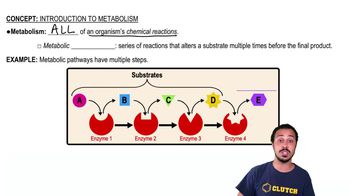
  • Metabolism

    All chemical reactions occurring within an organism, encompassing both energy-releasing and energy-consuming processes.
  • Metabolic Pathway

    A sequence of enzyme-catalyzed reactions transforming a starting molecule through several intermediates to a final product.
  • Substrate

    A molecule acted upon and altered by an enzyme during a chemical reaction within a pathway.
  • Product

    The final molecule generated after a series of enzyme-driven transformations in a metabolic sequence.
  • Enzyme

    A biological catalyst that accelerates specific chemical reactions, enabling metabolic pathways to proceed efficiently.
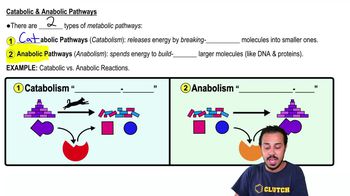
  • Catabolism

    A set of processes that break down large molecules into smaller ones, releasing energy in the process.
  • Anabolism

    A collection of reactions that assemble larger molecules from smaller units, requiring energy input.
  • Exergonic Process

    A reaction or pathway that results in the release of energy, often linked with the breakdown of molecules.
  • Endergonic Process

    A reaction or pathway that requires energy input, typically associated with the synthesis of complex molecules.
  • Catabolic Pathway

    A series of reactions focused on degrading complex molecules into simpler ones, coupled with energy release.
  • Anabolic Pathway

    A sequence of reactions dedicated to constructing complex molecules from simpler ones, consuming energy.
  • Chemical Reaction

    A process in which molecules are transformed into different molecules, forming the basis of metabolic activity.
  • Energy

    A vital resource required or released during metabolic transformations, driving both synthesis and breakdown.