Antimicrobial agents that damage nucleic acids also affect which cellular processes?
Antimicrobial agents that damage nucleic acids affect DNA replication, transcription, and overall genetic information transfer, disrupting essential cellular functions.
Microbial resistance to drugs is acquired through which genetic mechanisms?
Microbial resistance to drugs is acquired through mutations and horizontal gene transfer, such as transformation, transduction, and conjugation.
Genes for antibiotic resistance are often located where within microbial cells?
Genes for antibiotic resistance are often located on mobile genetic elements such as plasmids, which can be transferred between microbes via horizontal gene transfer.
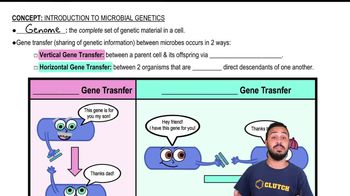
What is the definition of a genome in microbial genetics?
A genome is the complete set of genetic material in a cell, encompassing all of its DNA.
How does vertical gene transfer differ from horizontal gene transfer?
Vertical gene transfer occurs from parent to offspring, while horizontal gene transfer happens between unrelated organisms.
In gene transfer, what is the directionality of genetic material exchange?
Gene transfer is unidirectional, always moving from the donor cell to the recipient cell.
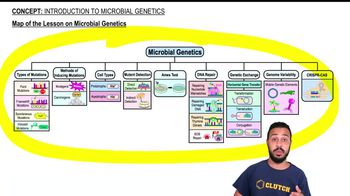
Name two types of mutations that will be discussed in the lesson on microbial genetics.
Two types of mutations discussed are point mutations and frameshift mutations.
What are mutagens and carcinogens, and how are they related to mutations?
Mutagens are agents that induce mutations, while carcinogens are mutagens that specifically cause cancer.
What is the purpose of the AIMS test in microbial genetics?
The AIMS test is used to identify mutagens by detecting their ability to induce mutations.
List two DNA repair mechanisms mentioned in the lesson overview.
Two DNA repair mechanisms mentioned are repairing nucleotide mismatches and repairing Thymine Dimers.
 Back
Back
 02:04
02:04