Skip to main content
Microbiology
My Course
Learn
Exam Prep
AI Tutor
Study Guides
Textbook Solutions
Flashcards
Explore
Try the app
My Course
Learn
Exam Prep
AI Tutor
Study Guides
Textbook Solutions
Flashcards
Explore
Try the app
Back
Introduction to Mutations definitions
You can tap to flip the card.
Mutation
You can tap to flip the card.
👆
Mutation
A permanent alteration in the DNA sequence that can impact cellular function as harmful, beneficial, or neutral.
Track progress
Control buttons has been changed to "navigation" mode.
1/15
Related flashcards
Related practice
Recommended videos
Introduction to Mutations quiz
Introduction to Mutations
15 Terms
Introduction to Mutations
16. Microbial Genetics
6 problems
Topic
Nicole
Methods of Inducing Mutations
16. Microbial Genetics
5 problems
Topic
Brendan
16. Microbial Genetics - Part 1 of 2
9 topics
14 problems
Chapter
Monica
16. Microbial Genetics - Part 2 of 2
8 topics
13 problems
Chapter
Nicole
02:47
Spontaneous vs. Induced Mutations
2236
views
21
rank
00:37
Introduction to Mutations
2237
views
29
rank
08:44
Types of Mutations
11442
views
122
rank
Terms in this set (15)
Hide definitions
Mutation
A permanent alteration in the DNA sequence that can impact cellular function as harmful, beneficial, or neutral.
DNA Sequence
The specific order of nucleotides in a DNA molecule, serving as the genetic blueprint for an organism.
Point Mutation
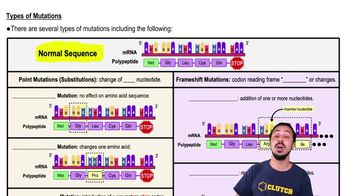
A genetic change involving the substitution of a single nucleotide, potentially altering one amino acid.
Frameshift Mutation
A genetic alteration caused by insertion or deletion of nucleotides, shifting the codon reading frame and affecting downstream amino acids.
Silent Mutation
A nucleotide change that does not alter the amino acid sequence of a protein, making the mutation undetectable at the protein level.
Missense Mutation
A single nucleotide change resulting in the substitution of one amino acid for another in a protein.
Nonsense Mutation
A single nucleotide change that introduces a premature stop codon, truncating the protein.
Insertion
The addition of one or more nucleotides into a DNA sequence, potentially shifting the reading frame.
Deletion
The removal of one or more nucleotides from a DNA sequence, which can alter the reading frame.
Codon Reading Frame
The sequential grouping of nucleotides into triplets, each specifying an amino acid during translation.
Spontaneous Mutation
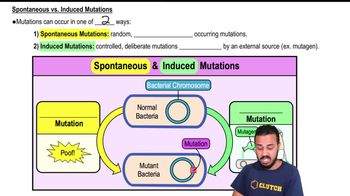
A random, naturally occurring genetic change arising from normal biological processes.
Induced Mutation
A controlled genetic change caused by external factors, often introduced deliberately by scientists.
Mutagen
An external chemical or agent capable of causing genetic changes in DNA.
Amino Acid Sequence
The specific order of amino acids in a protein, determined by the nucleotide sequence of mRNA.
Polypeptide
A chain of amino acids linked together, forming the primary structure of a protein.
 BackBack
 02:47
02:47