Skip to main content
Microbiology
My Course
Learn
Exam Prep
AI Tutor
Study Guides
Textbook Solutions
Flashcards
Explore
Try the app
My Course
Learn
Exam Prep
AI Tutor
Study Guides
Textbook Solutions
Flashcards
Explore
Try the app
Back
Introduction to Polymerase Chain Reaction definitions
You can tap to flip the card.
Polymerase Chain Reaction
You can tap to flip the card.
👆
Polymerase Chain Reaction
A laboratory method for rapidly generating millions of identical DNA sequences from a small initial sample, performed entirely in a test tube.
Track progress
Control buttons has been changed to "navigation" mode.
1/14
Related flashcards
Related practice
Recommended videos
Introduction to Polymerase Chain Reaction quiz #1
Introduction to Polymerase Chain Reaction
10 Terms
Introduction to Polymerase Chain Reaction
17. Biotechnology
4 problems
Topic
Nicole
The Steps of PCR
17. Biotechnology
4 problems
Topic
Brendan
17. Biotechnology
10 topics
14 problems
Chapter
Brendan
01:31
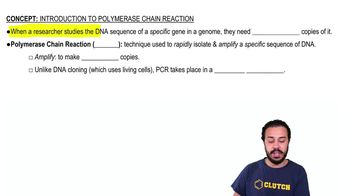
Introduction to Polymerase Chain Reaction
5825
views
61
rank
05:57
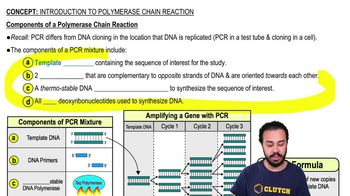
Components of a Polymerase Chain Reaction
5664
views
47
rank
02:53
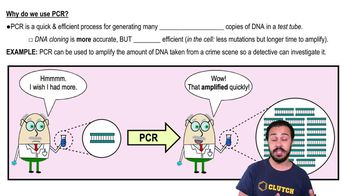
Why do we use PCR?
5597
views
54
rank
Terms in this set (14)
Hide definitions
Polymerase Chain Reaction
A laboratory method for rapidly generating millions of identical DNA sequences from a small initial sample, performed entirely in a test tube.
PCR
A widely used abbreviation for a technique that amplifies specific DNA segments quickly and efficiently outside living cells.
DNA Cloning
A process using living cells to produce multiple copies of DNA, typically slower but more accurate than test tube amplification.
Template DNA
A DNA molecule containing the target sequence to be copied during amplification in a test tube reaction.
DNA Primer
A short, single-stranded DNA fragment that binds to a complementary sequence, providing a starting point for DNA synthesis.
Thermostable DNA Polymerase
An enzyme capable of withstanding high temperatures, essential for synthesizing new DNA strands during repeated heating cycles.
Taq Polymerase
A heat-resistant enzyme commonly used to synthesize DNA in amplification reactions, derived from a thermophilic bacterium.
Deoxyribonucleotide
A building block of DNA, consisting of a nitrogenous base, deoxyribose sugar, and phosphate group, required for DNA synthesis.
Test Tube
A laboratory vessel where DNA amplification occurs outside of living cells, enabling rapid and controlled reactions.
Cycle
A single round of temperature changes in amplification, each potentially doubling the amount of target DNA present.
Exponent
A mathematical value indicating the number of amplification rounds, used to calculate the total DNA copies produced.
Genome
The complete set of genetic material within an organism, from which specific sequences can be targeted for amplification.
Nitrogenous Base
A molecular component of DNA nucleotides, such as adenine, thymine, cytosine, or guanine, essential for encoding genetic information.
Forensic Investigation
An application area where rapid DNA amplification is used to analyze genetic material from crime scenes.
 BackBack
 01:31
01:31