Skip to main content
Microbiology
My Course
Learn
Exam Prep
AI Tutor
Study Guides
Textbook Solutions
Flashcards
Explore
Try the app
My Course
Learn
Exam Prep
AI Tutor
Study Guides
Textbook Solutions
Flashcards
Explore
Try the app
Back
Introduction to Spontaneous Generation definitions
You can tap to flip the card.
Spontaneous Generation
You can tap to flip the card.
👆
Spontaneous Generation
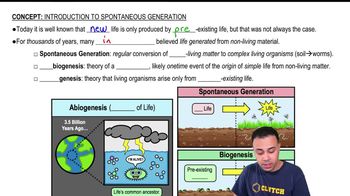
Belief in the regular formation of complex living organisms from nonliving matter, such as soil or rocks producing worms.
Track progress
Control buttons has been changed to "navigation" mode.
1/13
Related flashcards
Related practice
Recommended videos
Introduction to Spontaneous Generation quiz #1
Introduction to Spontaneous Generation
10 Terms
Introduction to Spontaneous Generation
2. Disproving Spontaneous Generation
4 problems
Topic
Nicole
Francesco Redi's Experiments
2. Disproving Spontaneous Generation
3 problems
Topic
Brendan
2. Disproving Spontaneous Generation
6 topics
11 problems
Chapter
Brendan
02:05
Biogenesis vs. Spontaneous Generation
3900
views
38
rank
05:59
Introduction to Spontaneous Generation
4381
views
87
rank
Terms in this set (13)
Hide definitions
Spontaneous Generation
Belief in the regular formation of complex living organisms from nonliving matter, such as soil or rocks producing worms.
Biogenesis
Theory stating that living organisms originate only from preexisting life, not from nonliving materials.
Abiogenesis
Concept describing a rare, likely one-time event where simple life first arose from nonliving materials billions of years ago.
Nonliving Matter
Substances like soil or rocks, considered incapable of producing life under current scientific understanding.
Complex Living Organisms
Multicellular entities such as worms or flies, believed by some to arise from nonliving matter in outdated theories.
Simple Living Organisms
Earliest forms of life, thought to have originated from nonliving materials in a unique ancient event.
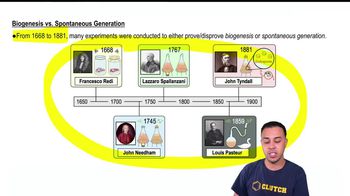
Francesco Redi
Scientist whose experiments provided evidence against spontaneous generation, supporting biogenesis.
John Needham
Researcher who attempted to support spontaneous generation, though his experiments contained flaws.
Lazaro Spallanzani
Experimenter whose work contradicted spontaneous generation and reinforced the concept of biogenesis.
Louis Pasteur
Pioneer whose experiments decisively disproved spontaneous generation and validated biogenesis.
John Tyndall
Scientist who conducted experiments supporting biogenesis and challenging spontaneous generation.
Preexisting Life
Source from which all current living organisms are derived, according to the principle of biogenesis.
Origin of Life
Event marking the emergence of the first simple living organism from nonliving materials on early Earth.
 BackBack
 02:05
02:05