Introduction to T Lymphocytes quiz #1 Flashcards

Introduction to T Lymphocytes quiz #1
Control buttons has been changed to "navigation" mode.
1/10
  • MHC, or major histocompatibility complex, proteins are responsible for displaying antigens to immune cells. What is the full name of MHC and what is its role in T cell activation?
    MHC stands for major histocompatibility complex. MHC proteins display antigens on the surface of antigen-presenting cells, allowing T cell receptors (TCRs) on T lymphocytes to recognize and bind to these antigens, which is essential for T cell activation.
  • Where do T lymphocytes develop before migrating to secondary lymphoid organs?
    T lymphocytes develop in the thymus before migrating to secondary lymphoid organs such as lymph nodes and the spleen.
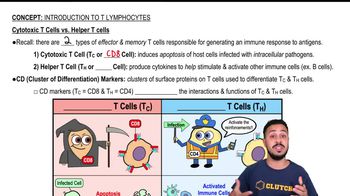
  • What is the main function of cytotoxic T cells in the immune response?
    Cytotoxic T cells induce apoptosis in host cells that are infected with intracellular pathogens.
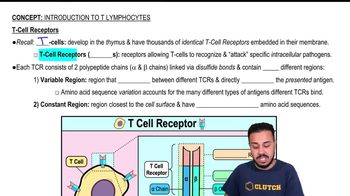
  • What are the two polypeptide chains that make up a T cell receptor (TCR)?
    A T cell receptor consists of an alpha chain and a beta chain, which are linked by disulfide bonds.
  • What is the difference between the variable and constant regions of a TCR?
    The variable region binds to presented antigens and varies between TCRs, while the constant region is near the cell surface and remains relatively unchanged.
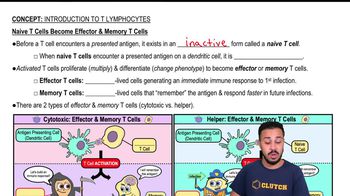
  • What triggers the activation of a naive T cell?
    A naive T cell is activated when it encounters its specific antigen presented by an antigen-presenting cell, such as a dendritic cell.
  • What are the two main types of effector T cells?
    The two main types of effector T cells are cytotoxic T cells (CD8) and helper T cells (CD4).
  • How do memory T cells contribute to immunity upon re-exposure to an antigen?
    Memory T cells provide a faster and stronger immune response when the body is exposed to the same antigen again.
  • What is the role of helper T cells in the immune system?
    Helper T cells produce cytokines that stimulate and activate other immune cells, such as B cells.
  • What do the CD8 and CD4 markers indicate on T cells?
    CD8 markers are found on cytotoxic T cells, while CD4 markers are found on helper T cells; these markers help differentiate the two cell types.