Introduction to Taxonomy quiz #1 Flashcards

Introduction to Taxonomy quiz #1
Control buttons has been changed to "navigation" mode.
1/10
  • According to Whittaker’s system of classification, how are living organisms grouped, and what are the main kingdoms identified in this system?
    Whittaker’s system classifies living organisms into five kingdoms: Monera, Protista, Fungi, Plantae, and Animalia, based on characteristics like cell type, complexity, and mode of nutrition.
  • Which of the following is false regarding the phylum Ascomycota?
    Ascomycota is a phylum of fungi, mostly multicellular, that reproduce sexually by forming ascospores in sac-like structures called asci. Any statement claiming Ascomycota is not a fungus or does not form asci would be false.
  • How do you determine the species of an unknown bacterium?
    To determine the species of an unknown bacterium, scientists use classification methods such as morphological observation, biochemical tests, genetic analysis, and comparison to known species in taxonomic databases.
  • How did the classification of microorganisms change from kingdoms to domains of life?
    Classification shifted from kingdoms to domains when scientists recognized fundamental differences between prokaryotic and eukaryotic cells, leading to the three-domain system: Bacteria, Archaea, and Eukarya.
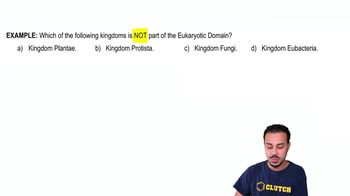
  • Protists and bacteria are grouped into different domains because:
    Protists are eukaryotic (have a nucleus) and belong to the domain Eukarya, while bacteria are prokaryotic (lack a nucleus) and belong to the domain Bacteria.
  • The four groups of protozoans are ______.
    The four groups of protozoans are typically classified by their movement: amoeboids (pseudopodia), flagellates (flagella), ciliates (cilia), and sporozoans (non-motile, often parasitic).
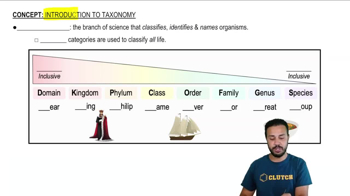
  • What is the purpose of the mnemonic 'Dear King Philip Came Over For Great Soup' in taxonomy?
    It helps students remember the order of the eight taxonomic categories: domain, kingdom, phylum, class, order, family, genus, and species, from most inclusive to least inclusive.
  • How do prokaryotic and eukaryotic cells differ in terms of cellular structure?
    Prokaryotic cells lack a nucleus and are always unicellular, while eukaryotic cells contain a nucleus and can be either unicellular or multicellular.
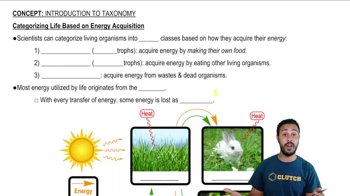
  • What is the role of decomposers in the cycling of matter within an ecosystem?
    Decomposers break down dead organisms and wastes, returning nutrients to the soil, which can then be used by producers, thus cycling matter through the ecosystem.
  • According to the phylogenetic tree, what does the horizontal axis represent and what does it suggest about the origin of life?
    The horizontal axis represents time, and it suggests that all life originated from a single common ancestor in the distant past.