Introduction to Viruses quiz #1 Flashcards

Introduction to Viruses quiz #1
1 student found this helpful
Control buttons has been changed to "navigation" mode.
1/19
  • Which of the following is a true statement about viruses?
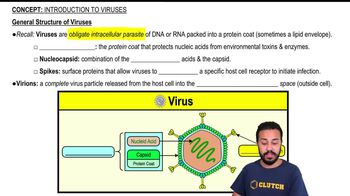
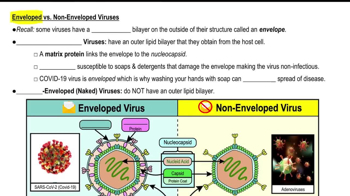
    Viruses are obligate intracellular parasites that contain either DNA or RNA within a protein coat called a capsid, and sometimes have a lipid envelope.
  • Which of the following statements is true about viruses?
    Viruses must enter a host cell to replicate and can have either DNA or RNA as their genetic material.
  • Which of these best describes a virus?
    A virus is a microscopic infectious agent composed of nucleic acid (DNA or RNA) surrounded by a protein coat, and sometimes a lipid envelope.
  • What type of RNA virus can use its RNA as a template to produce DNA?
    Retroviruses use their RNA as a template to produce DNA.
  • Which characteristic do viruses share with living things?
    Viruses can evolve and mutate over time.
  • What happens when a virus attacks a cell?
    The virus binds to specific receptors on the host cell, enters the cell, and uses the cell's machinery to replicate itself.
  • Which of the following is not a way to transmit the virus that causes HIV?
    Casual contact, such as hugging or sharing utensils, is not a way to transmit HIV.
  • Which viral stage occurs first during infection?
    Attachment to the host cell occurs first.
  • Are viruses considered alive by most scientists?
    Most scientists do not consider viruses to be alive because they cannot reproduce or carry out metabolism independently.
  • Which of the following is a trigger for a virus to infect a host cell?
    Binding of viral surface proteins (spikes) to specific host cell receptors triggers infection.
  • Which conclusion about the HIV infection of a host cell is best supported by the diagram?
    HIV binds to specific receptors on the host cell surface using its spike proteins to initiate infection.
  • Which of the following statements about viral spikes is false?
    Viral spikes are not involved in protecting the viral genetic material; they are used for binding to host cell receptors.
  • Viruses bind to receptors on host cell surfaces. What type of receptor does influenza virus bind?
    Influenza virus binds to sialic acid receptors on host cell surfaces.
  • What cycle does a virus use to destroy the host cell to reproduce the virus?
    The lytic cycle is used by viruses to destroy the host cell and release new viral particles.
  • Which of the following characteristics determine a virus's host range?
    The presence of specific receptors on the host cell surface determines a virus's host range.
  • Many animal viruses have proteins called spikes that attach to receptors on host cells.
    True. Spikes are surface proteins that help viruses attach to host cell receptors.
  • A virus mutates and therefore it has which of the following?
    A virus has genetic variability due to mutations.
  • Which replicative cycle describes a virus that can integrate its genome into the host cell's genome?
    The lysogenic cycle describes a virus that integrates its genome into the host cell's genome.
  • List the correct order of viral life cycle phases, starting with the first at the top.
    Attachment, entry, uncoating, replication, assembly, release.