Skip to main content
Microbiology
My Course
Learn
Exam Prep
AI Tutor
Study Guides
Textbook Solutions
Flashcards
Explore
Try the app
My Course
Learn
Exam Prep
AI Tutor
Study Guides
Textbook Solutions
Flashcards
Explore
Try the app
Back
Isotopes quiz
You can tap to flip the card.
What defines an isotope of an element?
You can tap to flip the card.
👆
What defines an isotope of an element?
Isotopes are atoms of the same element that differ in the number of neutrons.
Track progress
Control buttons has been changed to "navigation" mode.
1/15
Related flashcards
Related practice
Recommended videos
Isotopes definitions
Isotopes
15 Terms
Isotopes
3. Chemical Principles of Microbiology
4 problems
Topic
Brendan
Introduction to Chemical Bonding
3. Chemical Principles of Microbiology
6 problems
Topic
Brendan
3. Chemical Principles of Microbiology
7 topics
12 problems
Chapter
Nicole
06:50
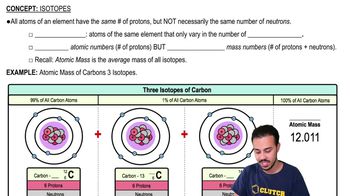
Isotopes
29951
views
589
rank
02:37
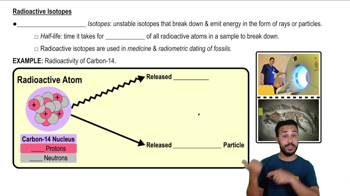
Radioactive Isotopes
20713
views
361
rank
Terms in this set (15)
Hide definitions
What defines an isotope of an element?
Isotopes are atoms of the same element that differ in the number of neutrons.
Do isotopes of an element have the same number of protons?
Yes, all isotopes of an element have the same number of protons.
What is the mass number of an atom?
The mass number is the sum of protons and neutrons in the nucleus of an atom.
How do isotopes of an element differ from each other?
Isotopes differ in the number of neutrons, which leads to different mass numbers.
What are the three isotopes of carbon and their neutron counts?
Carbon-12 has 6 neutrons, Carbon-13 has 7 neutrons, and Carbon-14 has 8 neutrons.
Which carbon isotope is the most abundant?
Carbon-12 is the most abundant, making up about 99% of all carbon atoms.
How is the atomic mass of an element determined?
Atomic mass is the average mass of all the isotopes of an element, weighted by their abundance.
What is a radioactive isotope?
A radioactive isotope is an unstable isotope that decays over time, emitting energy and particles.
What is meant by the half-life of a radioactive isotope?
Half-life is the time required for half of a radioactive sample to decay.
How many protons and neutrons does Carbon-14 have?
Carbon-14 has 6 protons and 8 neutrons.
Why do isotopes have different mass numbers?
Because they have different numbers of neutrons, which changes the total mass number.
What happens when the number of protons in an atom changes?
Changing the number of protons changes the element itself.
Name two uses of radioactive isotopes.
Radioactive isotopes are used in medicine and for radiometric dating of fossils.
Why is the atomic mass of carbon (12.011) not a whole number?
Because it is the weighted average of all carbon isotopes, not just the most common one.
What does the emission of energy and particles from a radioactive isotope indicate?
It indicates that the isotope is decaying and is unstable.
 BackBack
 06:50
06:50