Back

Krebs Cycle definitions

Control buttons has been changed to "navigation" mode.
1/14
  • Krebs Cycle

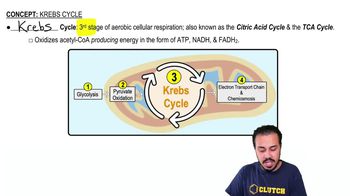
    Third stage of aerobic respiration, a series of reactions in mitochondria that oxidizes Acetyl CoA to generate energy carriers.
  • Citric Acid Cycle

    Alternate name for the Krebs Cycle, highlighting the formation of citrate as the first product.
  • TCA Cycle

    Another synonym for the Krebs Cycle, emphasizing its role in tricarboxylic acid metabolism.
  • Acetyl CoA

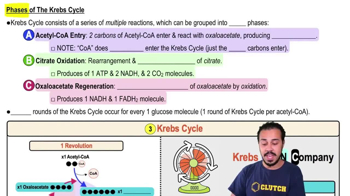
    Two-carbon molecule entering the Krebs Cycle, derived from pyruvate oxidation, fueling the cycle's reactions.
  • Oxaloacetate

    Four-carbon molecule that combines with Acetyl CoA to initiate the Krebs Cycle and is regenerated at the cycle's end.
  • Citrate

    Six-carbon molecule formed from Acetyl CoA and Oxaloacetate, marking the start of the Krebs Cycle.
  • NADH

    High-energy electron carrier produced during the Krebs Cycle, later used in the electron transport chain.
  • FADH2

    Electron carrier generated in the Krebs Cycle, contributing electrons to the electron transport chain.
  • ATP

    Energy currency molecule produced in small amounts during the Krebs Cycle via substrate-level phosphorylation.
  • CO2

    Waste product released during the Krebs Cycle, ultimately exhaled from the organism.
  • Aerobic Cellular Respiration

    Multi-stage process in cells using oxygen to extract energy from glucose, with the Krebs Cycle as its third stage.
  • Pyruvate Oxidation

    Pre-Krebs Cycle process converting pyruvate into Acetyl CoA, linking glycolysis to the Krebs Cycle.
  • Electron Transport Chain

    Final stage of aerobic respiration where NADH and FADH2 donate electrons to produce most cellular ATP.
  • Substrate-Level Phosphorylation

    Direct formation of ATP in the Krebs Cycle by transferring a phosphate group to ADP from an intermediate.