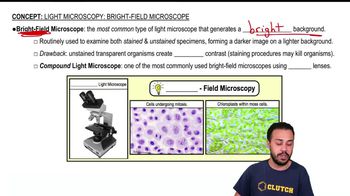
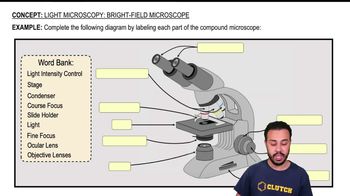
Bright-field microscopes use a combination of lenses and a light source to view a specimen. What are the two main lenses used in a compound bright-field microscope?
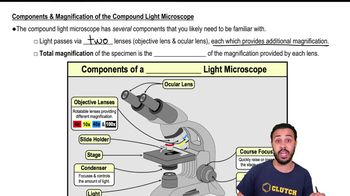
The two main lenses used in a compound bright-field microscope are the ocular lens and the objective lens.
What is the main drawback of using bright-field microscopy for viewing unstained transparent organisms?
The main drawback is poor contrast, making it difficult to see unstained transparent organisms against the bright background.
Why might staining not always be a suitable solution for improving contrast in bright-field microscopy?
Staining can kill the organisms, which may not be desirable if the scientist wants to observe living specimens.
What is the function of the condenser in a compound light microscope?
The condenser focuses and controls the amount of light that reaches the specimen.
How do the coarse and fine focus knobs differ in their operation on a compound light microscope?
The coarse focus knob quickly raises or lowers the stage, while the fine focus knob does so slowly for precise focusing.
What is the usual magnification of the ocular lens in a compound light microscope?
The ocular lens typically has a magnification of 10x.
How is the total magnification of a compound light microscope calculated?
Total magnification is calculated by multiplying the magnification of the ocular lens by that of the selected objective lens.
What are the typical magnifications provided by the objective lenses on a compound light microscope?
Objective lenses usually provide magnifications of 4x, 10x, 40x, and 100x.
What is the purpose of the stage and slide holder on a compound light microscope?
The stage supports the specimen slide, and the slide holder secures it in place to prevent movement during observation.
Why is the compound light microscope commonly used in introductory biology and microbiology labs?
It is widely used because it provides sufficient magnification and clarity for examining a variety of specimens in educational settings.