Microbiology
My Course
Learn
Exam Prep
AI Tutor
Study Guides
Textbook Solutions
Flashcards
Explore
My Course
Learn
Exam Prep
AI Tutor
Study Guides
Textbook Solutions
Flashcards
Explore
Back
Liquid Chemicals: Surface-Active Agents definitions
You can tap to flip the card.
Define:
Surfactant
You can tap to
flip the card.
👆
Surfactant
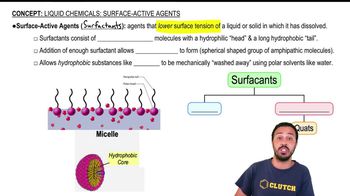
Amphipathic molecule that lowers surface tension, enabling the removal of hydrophobic substances and microbes by forming micelles.
Track progress
Control buttons has been changed to "navigation" mode.
1/14
Related practice
Recommended videos
Guided course
04:14
Liquid Chemicals: Surface-Active Agents
Jason
1214
views
12
rank
Guided course
06:20
Soaps & Detergents
Jason
1152
views
10
rank
Guided course
02:33
Quats
Jason
1060
views
10
rank
Terms in this set (14)
Hide definitions
Surfactant
Amphipathic molecule that lowers surface tension, enabling the removal of hydrophobic substances and microbes by forming micelles.
Surface Tension
Physical property reduced by amphipathic agents, allowing liquids to spread and mix more easily with other substances.
Amphipathic Molecule
Chemical structure containing both hydrophilic and hydrophobic regions, enabling interaction with water and nonpolar substances.
Hydrophilic Head
Polar region of a molecule that interacts favorably with water, often carrying a charge.
Hydrophobic Tail
Nonpolar region of a molecule that avoids water, typically forming the core of micelles.
Micelle
Spherical assembly of amphipathic molecules with hydrophobic cores that trap oils and microbes for removal.
Soap
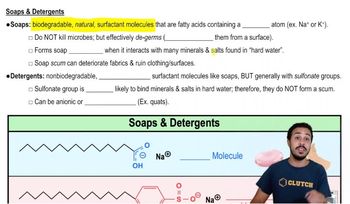
Biodegradable surfactant made from fatty acids and salts, effective at degerming but not inherently antimicrobial.
Degerming
Physical removal of microbes from surfaces, often achieved by surfactants like soaps.
Soap Scum
Residue formed when soap reacts with minerals in hard water, potentially damaging fabrics and surfaces.
Detergent
Synthetic, non-biodegradable surfactant, often containing sulfonate groups, effective in hard water without forming scum.
Sulfonate Group
Functional group in detergents that resists binding with minerals, preventing scum formation in hard water.
Quaternary Ammonium Compound
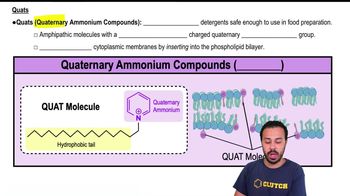
Cationic detergent with antimicrobial properties, capable of disrupting microbial membranes and safe for food preparation.
Cationic Detergent
Positively charged synthetic surfactant, often with antimicrobial activity, such as quaternary ammonium compounds.
Phospholipid Bilayer
Structural component of cell membranes targeted and disrupted by certain antimicrobial surfactants like quats.