Microbiology
My Course
Learn
Exam Prep
AI Tutor
Study Guides
Textbook Solutions
Flashcards
Explore
My Course
Learn
Exam Prep
AI Tutor
Study Guides
Textbook Solutions
Flashcards
Explore
Back
Magnification, Resolution, & Contrast quiz
You can tap to flip the card.
Define:
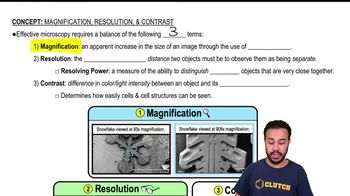
What is magnification in microscopy?
You can tap to flip the card.
👆
What is magnification in microscopy?
Magnification is the apparent increase in the size of an image through the use of lenses.
Track progress
Control buttons has been changed to "navigation" mode.
1/15
Related flashcards
Related practice
Recommended videos
Magnification, Resolution, & Contrast definitions
Magnification, Resolution, & Contrast
13 Terms
Magnification, Resolution, & Contrast
9. Microscopes
7 problems
Topic

Nicole
Introduction to Light Microscopy
9. Microscopes
Topic
9. Microscopes - Part 1 of 2
6 topics
12 problems
Chapter
Nicole
9. Microscopes - Part 2 of 2
8 topics
10 problems
Chapter
Nicole
Guided course
07:29
Magnification, Resolution, & Contrast
Jason
3031
views
44
rank
Terms in this set (15)
Hide definitions
What is magnification in microscopy?
Magnification is the apparent increase in the size of an image through the use of lenses.
How does increasing magnification affect the apparent size of an object?
Increasing magnification makes the apparent size of the object larger compared to its actual size.
What does 93x magnification mean?
It means the image appears 93 times larger than the actual size of the object.
What is resolution in microscopy?
Resolution is the minimum distance two objects must be apart to be observed as separate entities.
What is resolving power?
Resolving power is a measure of the ability to distinguish two separate objects that are very close together.
Why is high resolution important in microscopy?
High resolution allows you to see two close objects as separate, making the image clearer and more detailed.
Can two objects appear as one if the resolution is poor?
Yes, with poor resolution, two close objects may appear as a single object.
What is contrast in microscopy?
Contrast is the difference in color or light intensity between an object and its background.
Why is contrast important for visualizing cells?
Contrast helps objects stand out from the background, making cells and structures easier to see.
What happens when contrast is low?
When contrast is low, the object and background look similar, making it hard to distinguish the object.
How does high contrast affect the visibility of objects?
High contrast makes objects much easier to visualize because they stand out clearly from the background.
Is magnification alone enough for effective microscopy?
No, effective microscopy requires a balance of magnification, resolution, and contrast.
What can happen if you have high magnification but poor resolution and contrast?
Even with high magnification, poor resolution and contrast can make it difficult to see details clearly.
What analogy was used to describe the effect of resolution?
Resolution was compared to putting on eyeglasses to make an image appear clearer and more crisp.
Why is it important to balance magnification, resolution, and contrast in microscopy?
Balancing all three ensures you can effectively use a microscope to study microbes and see details clearly.