Back

Measuring Growth by Direct Cell Counts quiz #1

Control buttons has been changed to "navigation" mode.
1/9
  • A direct cell count determines the number of ______ in a sample.

    A direct cell count determines the number of total cells (including both viable and dead cells) in a sample.
  • What is a major limitation of direct cell counting methods when determining cell numbers in a culture?

    Direct cell counting methods cannot distinguish between living (viable) and dead cells, so both are included in the total count.
  • How does a gridded cover slip aid in direct microscopic cell counts?

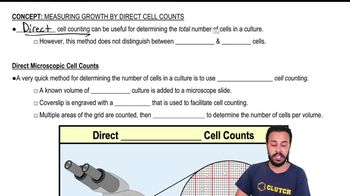
    A gridded cover slip provides defined areas for counting, making it easier to count cells and calculate averages for cell concentration.
  • Why is manual direct microscopic cell counting considered error-prone and time-consuming?

    Manual counting requires careful observation and tallying of cells in multiple grid areas, which can lead to mistakes and takes a long time.
  • What is the principle behind cell detection in a flow cytometer?

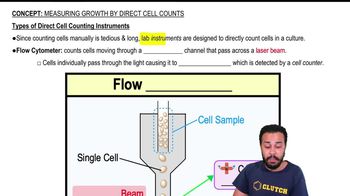
    Cells pass through a narrow channel and a laser beam; the scattered light from each cell is detected and counted by the instrument.
  • How does a Coulter counter differ from a flow cytometer in detecting cells?

    A Coulter counter detects cells electronically as they pass through a channel, rather than by measuring scattered light.
  • What is the purpose of averaging cell counts from multiple grid areas in direct microscopic cell counting?

    Averaging counts from multiple grid areas helps provide a more accurate estimate of the number of cells per volume in the sample.
  • What type of microscope is typically used for direct microscopic cell counts?

    A compound light microscope is commonly used for direct microscopic cell counts.
  • Why might a scientist choose a direct cell counting method even if it includes dead cells?

    In some cases, knowing the total number of cells, regardless of viability, is sufficient for the scientist's research needs.