Skip to main content
Microbiology
My Course
Learn
Exam Prep
AI Tutor
Study Guides
Textbook Solutions
Flashcards
Explore
Try the app
My Course
Learn
Exam Prep
AI Tutor
Study Guides
Textbook Solutions
Flashcards
Explore
Try the app
Back
Meselson-Stahl Experiment quiz
You can tap to flip the card.
What is the main conclusion of the Meselson-Stahl experiment?
You can tap to flip the card.
👆
What is the main conclusion of the Meselson-Stahl experiment?
The experiment confirmed that DNA replicates via the semi-conservative model, where each new DNA molecule contains one old strand and one new strand.
Track progress
Control buttons has been changed to "navigation" mode.
1/15
Related flashcards
Related practice
Recommended videos
Meselson-Stahl Experiment definitions
Meselson-Stahl Experiment
15 Terms
Meselson-Stahl Experiment
14. DNA Replication
3 problems
Topic
Brendan
Introduction to DNA Replication
14. DNA Replication
3 problems
Topic
Brendan
14. DNA Replication
10 topics
14 problems
Chapter
Brendan
09:03
Meselson-Stahl Experiment
12027
views
128
rank
Terms in this set (15)
Hide definitions
What is the main conclusion of the Meselson-Stahl experiment?
The experiment confirmed that DNA replicates via the semi-conservative model, where each new DNA molecule contains one old strand and one new strand.
Which organism did Meselson and Stahl use in their experiment?
They used the bacterium Escherichia coli (E. coli).
What isotopes of nitrogen were used in the Meselson-Stahl experiment?
Nitrogen-15 (N-15) and Nitrogen-14 (N-14) were used to label DNA strands.
How does the semi-conservative model of DNA replication work?
Each new DNA molecule consists of one parental (old) strand and one newly synthesized strand.
What did the conservative model of DNA replication propose?
It proposed that the original DNA molecule is fully conserved and a completely new molecule is synthesized.
Why was the dispersive model of DNA replication rejected?
Because the experiment showed that DNA strands were not a mix of old and new segments, but rather one old and one new strand.
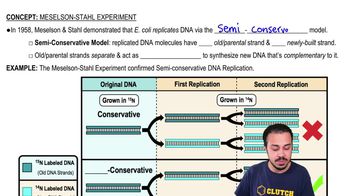
How were old and new DNA strands distinguished in the experiment?
Old strands were labeled with N-15 (dark blue), and new strands were labeled with N-14 (light blue).
What was the result after one round of replication in N-14 medium?
DNA molecules contained one strand with N-15 and one with N-14, supporting the semi-conservative model.
What does the term 'semi-conservative' mean in the context of DNA replication?
It means that each replicated DNA molecule contains one original (parental) strand and one new strand.
What did Meselson and Stahl do after growing E. coli in N-15 medium?
They switched the bacteria to N-14 medium to track the incorporation of new nitrogen into DNA.
How did the results of the experiment disprove the conservative model?
The results did not show completely old or completely new DNA molecules, as the conservative model predicted.
What did further rounds of replication in N-14 medium show?
They continued to support the semi-conservative model, with each new DNA strand pairing with an old strand from the previous generation.
What role did the old parental DNA strands play during replication?
They separated and acted as templates for the synthesis of new complementary DNA strands.
Why is the Meselson-Stahl experiment considered a classic in molecular biology?
Because it provided clear experimental evidence for the mechanism of DNA replication.
What is the key takeaway from the Meselson-Stahl experiment?
DNA replicates in a semi-conservative manner, with each new molecule containing one old and one new strand.
 BackBack
 09:03
09:03