Skip to main content
Microbiology
My Course
Learn
Exam Prep
AI Tutor
Study Guides
Textbook Solutions
Flashcards
Explore
Try the app
My Course
Learn
Exam Prep
AI Tutor
Study Guides
Textbook Solutions
Flashcards
Explore
Try the app
Back
Needham vs. Spallanzani definitions
You can tap to flip the card.
Spontaneous Generation
You can tap to flip the card.
👆
Spontaneous Generation
A disproven concept suggesting that living organisms can arise from nonliving matter under certain conditions.
Track progress
Control buttons has been changed to "navigation" mode.
1/15
Related flashcards
Related practice
Recommended videos
Needham vs. Spallanzani quiz
Needham vs. Spallanzani
15 Terms
Needham vs. Spallanzani
2. Disproving Spontaneous Generation
3 problems
Topic
Nicole
Pasteur's Experiments on Spontaneous Generation
2. Disproving Spontaneous Generation
5 problems
Topic
Nicole
2. Disproving Spontaneous Generation
6 topics
11 problems
Chapter
Brendan
05:56
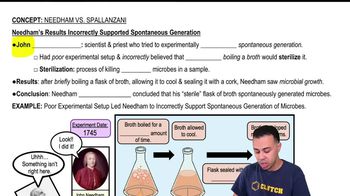
Needham vs. Spallanzani
4241
views
60
rank
05:34
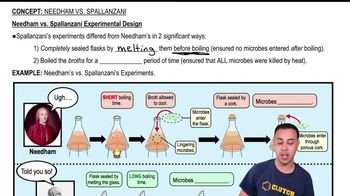
Needham vs. Spallanzani Experimental Design
2615
views
30
rank
07:22
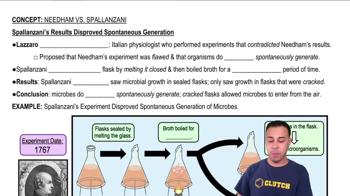
Spallanzani’s Results Disproved Spontaneous Generation
3019
views
43
rank
Terms in this set (15)
Hide definitions
Spontaneous Generation
A disproven concept suggesting that living organisms can arise from nonliving matter under certain conditions.
Sterilization
A process intended to eliminate all forms of microbial life from a substance, often requiring sufficient heat exposure.
Contamination
The unintended introduction of microbes into a sterile environment, often compromising experimental results.
Broth
A nutrient-rich liquid medium used to support the growth of microorganisms in laboratory experiments.
Cork
A porous material used to seal flasks, which can allow microbes to pass through and contaminate contents.
Melted Glass Seal
A method of closing flasks by fusing glass, creating an airtight barrier that prevents microbial entry.
Microbial Growth
The increase in number of microorganisms, often visible as cloudiness or colonies in a nutrient medium.
Experimental Setup
The specific arrangement and procedures used in scientific investigations, crucial for obtaining valid results.
Biogenesis
A principle stating that life arises only from pre-existing life, not from nonliving material.
Porous Material
A substance containing tiny holes that permit the passage of air or microbes, potentially leading to contamination.
Cooling Period
The interval after heating during which a substance returns to room temperature, often a window for contamination.
Skepticism
A critical attitude or doubt regarding experimental conclusions, often driving further scientific inquiry.
Vital Force
A hypothesized essential element, such as oxygen, once believed necessary for spontaneous generation.
Custom Flask
A specially designed container used in experiments to control variables like air exposure and contamination.
Physiologist
A scientist specializing in the study of biological functions and processes in living organisms.
 BackBack
 05:56
05:56