Back

Osmolarity Factors for Microbial Growth definitions

1 student found this helpful
Control buttons has been changed to "navigation" mode.
1/14
  • Osmolarity

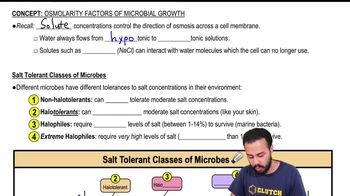
    Measure of solute concentration affecting water movement across cell membranes, crucial for microbial survival.
  • Osmosis

    Passive movement of water from low to high solute concentration, balancing cellular environments.
  • Cell Membrane

    Selective barrier regulating entry and exit of water and solutes, influencing microbial growth.
  • Solute

    Dissolved substance, such as NaCl, that can bind water molecules and impact cellular water availability.
  • NaCl

    Common salt that interacts with water, reducing its availability for cellular processes in microbes.
  • Nonhalotolerant

    Microbe group thriving only in environments with nearly zero salt, unable to survive moderate salinity.
  • Halotolerant

    Microbe group capable of surviving moderate salt levels, with optimal growth around 3-4% salt.
  • Halophile

    Microbe group requiring high salt concentrations (1-14%) for survival, with optimal growth near 6% salt.
  • Extreme Halophile

    Microbe group thriving only in very high salt environments, above 15%, such as the Great Salt Lake.
  • Growth Rate

    Speed at which microbial populations increase, influenced by environmental salt concentration.
  • Hypotonic Environment

    Condition where external solute concentration is lower than inside the cell, promoting water influx.
  • Hypertonic Environment

    Condition where external solute concentration exceeds that inside the cell, causing water efflux.
  • Salt Tolerance

    Ability of microbes to survive and grow in environments with varying salt concentrations.
  • Marine Bacteria

    Microorganisms adapted to live in salty seawater, often classified as halophiles.