Back

Osmolarity Factors for Microbial Growth quiz

Control buttons has been changed to "navigation" mode.
1/15
  • What controls the direction of osmosis across a cell membrane?

    Solute concentrations control the direction of osmosis across a cell membrane.
  • In osmosis, from which environment does water flow and to which environment does it move?

    Water flows from hypotonic environments to hypertonic environments during osmosis.
  • How does sodium chloride (NaCl) affect water molecules in microbial environments?

    NaCl interacts with water molecules, making them unavailable for cellular use.
  • What impact does salt concentration have on microbial growth?

    Salt concentration can limit or promote microbial growth depending on the microbe's salt tolerance.
  • How are microbes classified based on their salt tolerance?

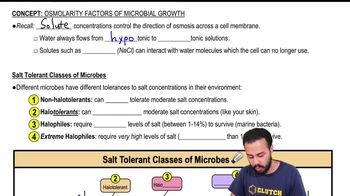
    Microbes are classified into four groups: nonhalotolerants, halotolerants, halophiles, and extreme halophiles.
  • What environment do nonhalotolerant microbes thrive in?

    Nonhalotolerant microbes thrive in environments with nearly 0% salt concentration.
  • What is the salt concentration range that halotolerant microbes can endure?

    Halotolerant microbes can endure moderate salt levels, with optimal growth around 3-4% salt concentration.
  • Where might you find halotolerant microbes in the human body?

    Halotolerant microbes may survive on the skin, which can provide a moderately salty environment.
  • What salt concentration do halophiles require for survival?

    Halophiles require high salt concentrations, typically between 1-14%.
  • What is the optimal salt concentration for halophile growth?

    Halophiles grow best at around 6% salt concentration.
  • What types of environments do extreme halophiles thrive in?

    Extreme halophiles thrive in environments with very high salt concentrations, above 15%.
  • What is an example of an environment where extreme halophiles can grow?

    Extreme halophiles can grow in the Great Salt Lakes, which have about 25% salt concentration.
  • How does the growth rate of nonhalotolerant microbes change as salt concentration increases?

    The growth rate of nonhalotolerant microbes decreases as salt concentration increases.
  • At what salt concentration do halotolerant microbes stop growing optimally?

    Halotolerant microbes stop growing optimally as salt concentrations rise above about 10%.
  • How is microbial growth rate represented in the graphical model discussed in the lesson?

    Microbial growth rate is shown on the y-axis, while environmental salt concentration is on the x-axis.