Back

Oxygen Requirements for Microbial Growth quiz

1 student found this helpful
Control buttons has been changed to "navigation" mode.
1/15
  • What is the final electron acceptor for aerobes in their electron transport chain?

    Aerobes use oxygen gas (O2) as the final electron acceptor in their electron transport chain, which is essential for energy generation.
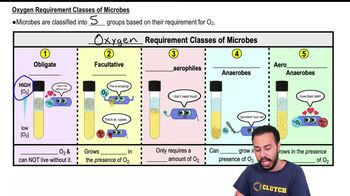
  • How do obligate aerobes differ from obligate anaerobes in terms of oxygen requirements?

    Obligate aerobes require oxygen to survive and grow only where oxygen is abundant, while obligate anaerobes cannot survive in the presence of oxygen and grow only where there is no oxygen.
  • Where in a test tube would you expect to find the most growth of obligate aerobes?

    Obligate aerobes grow only at the top of the test tube where oxygen concentration is highest.
  • What is a facultative anaerobe and where does it grow best?

    A facultative anaerobe can grow in both the presence and absence of oxygen but grows best in oxygen-rich environments.
  • Why do facultative anaerobes grow better in the presence of oxygen?

    They generate more ATP (energy) when oxygen is present, allowing for better growth.
  • What are microaerophiles and what oxygen concentration do they require?

    Microaerophiles require only small amounts of oxygen because high concentrations are toxic to them.
  • Where would you find microaerophiles growing in a test tube with an oxygen gradient?

    Microaerophiles grow in a narrow band just below the top of the test tube, where oxygen concentration is low but present.
  • What is an aerotolerant anaerobe and how does it grow in relation to oxygen?

    Aerotolerant anaerobes grow equally well in both the presence and absence of oxygen.
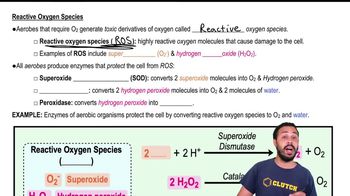
  • What are reactive oxygen species (ROS) and why are they problematic for aerobes?

    Reactive oxygen species (ROS) are highly reactive oxygen molecules like superoxide and hydrogen peroxide that can damage cells.
  • Name two examples of reactive oxygen species produced by aerobes.

    Superoxide (O2−) and hydrogen peroxide (H2O2) are two examples of reactive oxygen species.
  • What enzyme converts superoxide into hydrogen peroxide and oxygen gas?

    Superoxide dismutase (SOD) converts two superoxide molecules into hydrogen peroxide and oxygen gas.
  • How does catalase protect aerobes from hydrogen peroxide?

    Catalase converts two hydrogen peroxide molecules into two water molecules and oxygen gas, which are non-toxic.
  • What is the function of peroxidase in aerobes?

    Peroxidase converts hydrogen peroxide and hydrogen ions into water, helping to detoxify reactive oxygen species.
  • Which bacterium is an example of an obligate aerobe?

    Mycobacterium tuberculosis is an example of an obligate aerobe.
  • Where is Bacteroides fragilis typically found and what is its oxygen requirement?

    Bacteroides fragilis is found in the human gastrointestinal tract and is an obligate anaerobe, thriving in environments with little to no oxygen.