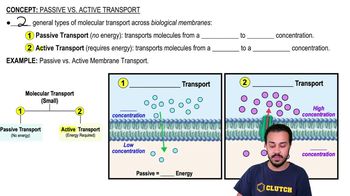
What is the main difference between passive and active transport?
Passive transport does not require energy and moves molecules from high to low concentration, while active transport requires energy and moves molecules from low to high concentration.
In which direction do molecules move during passive transport?
Molecules move from an area of high concentration to an area of low concentration during passive transport.
Does passive transport require energy input from the cell?
No, passive transport does not require any energy input from the cell.
What form of energy is required for active transport?
Active transport requires energy in the form of ATP.
How do molecules move during active transport?
Molecules move from an area of low concentration to an area of high concentration during active transport.
What is a uniporter?
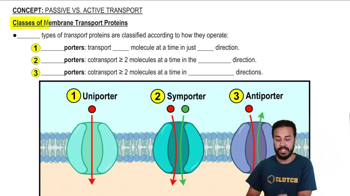
A uniporter is a transport protein that moves a single molecule in one direction across the membrane.
How many molecules does a uniporter transport at a time?
A uniporter transports one molecule at a time.
What is a symporter?
A symporter is a transport protein that co-transports two or more molecules in the same direction across the membrane.
In which direction do symporters move molecules?
Symporters move two or more molecules in the same direction across the membrane.
What is an antiporter?
An antiporter is a transport protein that moves two or more molecules in opposite directions across the membrane.
How do antiporters differ from symporters?
Antiporters transport molecules in opposite directions, while symporters transport them in the same direction.
What does the prefix 'uni-' in uniporter indicate?
The prefix 'uni-' means one, indicating that uniporters transport one molecule at a time.
What does the prefix 'sym-' in symporter suggest about the direction of transport?
'Sym-' suggests that molecules are transported in the same direction.
What does the prefix 'anti-' in antiporter indicate?
'Anti-' means opposite, indicating that antiporters move molecules in opposite directions.
Why is ATP necessary for active transport but not for passive transport?
ATP is necessary for active transport because it moves molecules against their concentration gradient, which requires energy, unlike passive transport.
 Back
Back
 03:41
03:41