Back

Pentose-Phosphate Pathway quiz

Control buttons has been changed to "navigation" mode.
1/15
  • What is the main function of the Pentose Phosphate Pathway (PPP)?

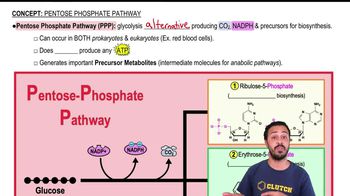
    The PPP is an alternative to glycolysis that produces NADPH, carbon dioxide, and important precursor metabolites for biosynthetic reactions.
  • Does the Pentose Phosphate Pathway produce ATP?

    No, the PPP does not produce ATP; it generates precursor metabolites and NADPH instead.
  • What important electron carrier is produced by the PPP?

    The PPP produces NADPH, which is essential for biosynthetic reactions.
  • In which types of cells does the Pentose Phosphate Pathway occur?

    The PPP occurs in both prokaryotes and eukaryotes, including red blood cells.
  • What is ribulose 5-phosphate, and why is it important?

    Ribulose 5-phosphate is a precursor metabolite produced by the PPP, and it is important for nucleotide biosynthesis.
  • Which amino acids are synthesized using erythrose 5-phosphate from the PPP?

    Erythrose 5-phosphate is used to synthesize aromatic amino acids such as Tyrosine and Tryptophan.
  • How does the PPP connect to glycolysis?

    The PPP produces glyceraldehyde 3-phosphate (G3P), which is a glycolysis intermediate and can feed back into glycolysis.
  • What are precursor metabolites, and why are they important in the PPP?

    Precursor metabolites are intermediate molecules used in anabolic pathways to build cell molecules and structures; the PPP generates several of these.
  • What is the significance of NADPH produced by the PPP?

    NADPH is an electron carrier crucial for biosynthetic (anabolic) reactions in the cell.
  • What is the fate of G3P produced by the PPP?

    G3P can be fed back into the energy harvest phase of glycolysis to continue cellular respiration.
  • What is the role of the PPP in nucleotide biosynthesis?

    The PPP produces ribulose 5-phosphate, which is necessary for the synthesis of nucleotides used in DNA and RNA.
  • What gas is released as a byproduct of the PPP?

    Carbon dioxide (CO2) is released as a byproduct of the PPP.
  • Why is the PPP considered an alternative to glycolysis?

    The PPP provides a different pathway for glucose breakdown, focusing on producing NADPH and precursor metabolites rather than ATP.
  • What is the importance of erythrose 5-phosphate in the cell?

    Erythrose 5-phosphate is a precursor for the biosynthesis of specific amino acids, especially aromatic ones.
  • How does the PPP support anabolic pathways?

    The PPP generates NADPH and precursor metabolites needed for building cell molecules and structures in anabolic pathways.