Back

Plaque Assays definitions

Control buttons has been changed to "navigation" mode.
1/14
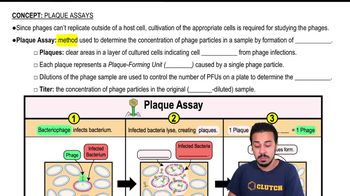
  • Plaque Assay

    Laboratory method used to quantify phage particles by counting clear zones formed on a bacterial lawn.
  • Bacteriophage

    Virus that infects and replicates within bacteria, requiring host cells for reproduction.
  • Plaque

    Clear area in a layer of cultured cells indicating cell death due to phage-induced lysis.
  • Plaque Forming Unit

    Measurement unit representing a single infectious phage particle capable of forming one clear zone.
  • Titer

    Concentration of phage particles in an original, undiluted sample, determined by plaque counts.
  • Dilution

    Process of reducing phage concentration to obtain countable numbers of clear zones on a plate.
  • Lawn of Bacteria

    Continuous layer of bacterial growth on a petri dish, serving as host cells for phage infection.
  • Cell Lysis

    Destruction of bacterial cells, resulting in release of phages and formation of clear zones.
  • Phage Infection

    Process where a virus invades a bacterial cell, leading to cell death and plaque formation.
  • Lytic Cycle

    Viral replication process resulting in host cell destruction and release of new phage particles.
  • Cultured Cells

    Bacterial cells grown under controlled conditions, used as hosts in laboratory assays.
  • Petri Dish

    Shallow cylindrical container used to culture bacteria and observe plaque formation.
  • Host Cell

    Bacterial cell required for viral replication and plaque development in assays.
  • Phage Particle

    Individual viral entity capable of infecting bacteria and initiating plaque formation.