Back

Plaque Assays quiz

Control buttons has been changed to "navigation" mode.
1/15
  • What is the main purpose of a plaque assay?

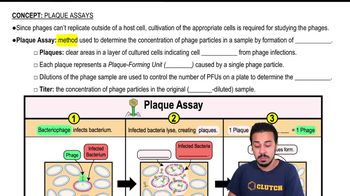
    A plaque assay is used to determine the concentration of bacteriophage particles in a sample.
  • Why are host cells required for studying bacteriophages?

    Bacteriophages are obligate intracellular parasites and cannot replicate outside of host cells.
  • What does a plaque represent in a plaque assay?

    A plaque represents a clear area in cultured cells caused by cell death from phage infection.
  • What is a plaque forming unit (PFU)?

    A PFU is a single plaque that correlates to one phage particle.
  • How is the titer of a phage sample determined in a plaque assay?

    The titer is determined by counting the number of plaques and using dilutions to estimate the concentration of phage particles in the original sample.
  • What does the titer indicate in a plaque assay?

    The titer indicates the concentration of phage particles in the original, undiluted sample.
  • What happens to bacteria when they are infected by phages in a plaque assay?

    The infected bacteria undergo lysis and die, forming clear plaques on the plate.
  • How does the lytic cycle contribute to plaque formation?

    The lytic cycle causes infected bacteria to lyse, resulting in cell death and the formation of plaques.
  • Why are dilutions of the phage sample important in plaque assays?

    Dilutions control the number of PFUs on the plate, making it possible to accurately count plaques and determine titer.
  • What does each plaque on a plate correspond to?

    Each plaque corresponds to one phage particle that infected and lysed bacteria.
  • How can the number of plaques be used in a plaque assay?

    The number of plaques can be used to estimate the number of phages and calculate the titer of the sample.
  • What is observed on a petri dish after phage infection in a plaque assay?

    Clear areas called plaques are observed, indicating regions where bacteria have been killed by phages.
  • What is the relationship between PFU and phage particles?

    One PFU represents one phage particle.
  • What is the first step in performing a plaque assay?

    The first step is growing a lawn of bacteria on a petri dish.
  • What does a cleared out area on a bacterial lawn indicate in a plaque assay?

    A cleared out area indicates cell death due to phage infection, forming a plaque.