Prokaryotic & Eukaryotic Cells quiz #1 Flashcards

Prokaryotic & Eukaryotic Cells quiz #1
Control buttons has been changed to "navigation" mode.
1/10
  • Which of the following is not an organelle that prokaryotic and eukaryotic cells share?
    The nucleus is not shared by prokaryotic and eukaryotic cells; only eukaryotic cells have a nucleus.
  • Which of the following is found in all prokaryotic cells but only some eukaryotic cells?
    A cell wall is found in all prokaryotic cells but only in some eukaryotic cells.
  • How are bacterial cells and human cells alike?
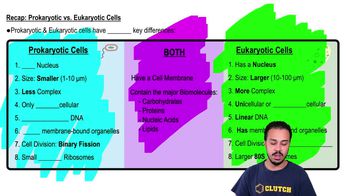
    Both bacterial and human cells have a cell membrane, ribosomes, and contain major biomolecules such as proteins, carbohydrates, nucleic acids, and lipids.
  • Which characteristics do all bacteria and archaea have in common?
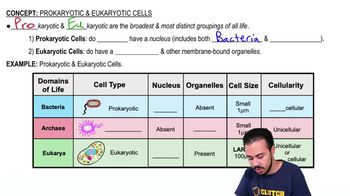
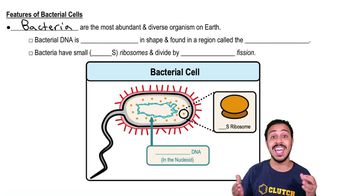
    Both bacteria and archaea are prokaryotic, lack a nucleus and membrane-bound organelles, have circular DNA, are unicellular, and divide by binary fission.
  • In which way are bacteria and eukaryotes the same?
    Both bacteria and eukaryotes have a cell membrane and ribosomes, and contain essential biomolecules.
  • Which of the following makes bacteria and archaea different from eukaryotes?
    Bacteria and archaea lack a nucleus and membrane-bound organelles, while eukaryotes have both.
  • Which of these strategies do prokaryotic cells use to isolate and organize their chemical reactions?
    Prokaryotic cells use specialized regions within the cytoplasm, such as the nucleoid, to organize their chemical reactions, but do not have membrane-bound organelles.
  • Which pair of microscope views represents a eukaryotic cell and a prokaryotic cell?
    A eukaryotic cell will appear larger and contain a nucleus and organelles, while a prokaryotic cell will be smaller and lack a nucleus and organelles.
  • Bacterial cells are prokaryotic. Unlike a typical eukaryotic cell, they .
    Bacterial cells lack a nucleus and membrane-bound organelles, have circular DNA, and divide by binary fission.
  • Which types of microorganisms have cells that do not contain organelles?
    Bacteria and archaea are microorganisms with cells that do not contain membrane-bound organelles.