Back

Prokaryotic Flagellar Movement definitions

Control buttons has been changed to "navigation" mode.
1/13
  • Motility

    Ability of an organism to move independently, crucial for navigating and adapting to various environments.
  • Swimming Motility

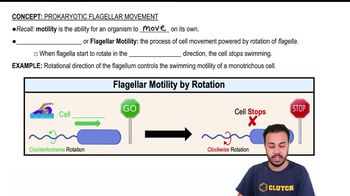
    Type of movement powered by flagellar rotation, allowing cells to traverse liquid environments efficiently.
  • Flagellar Motility

    Movement mechanism in which rotation of whip-like appendages propels prokaryotic cells through their surroundings.
  • Flagella

    Helical, filamentous structures extending from cells, whose rotation drives movement in prokaryotes.
  • Monotrichous Cell

    Bacterial cell possessing a single flagellum at one pole, enabling directed swimming.
  • Peritrichous Cell

    Bacterial cell with multiple flagella distributed over its surface, allowing complex movement patterns.
  • Run

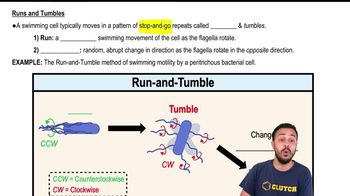
    Smooth, straight movement phase resulting from coordinated, unidirectional flagellar rotation.
  • Tumble

    Abrupt, random change in direction caused by reversal of flagellar rotation, leading to reorientation.
  • Counterclockwise Rotation

    Flagellar movement direction that typically results in smooth, forward propulsion of the cell.
  • Clockwise Rotation

    Flagellar movement direction that disrupts smooth swimming, causing the cell to stop or change direction.
  • Proton Motive Force

    Electrochemical gradient across the membrane that supplies energy for flagellar rotation and cell movement.
  • Rotation

    Spinning motion of flagella that determines the direction and type of cellular movement in prokaryotes.
  • Swimming Pattern

    Alternating sequence of runs and tumbles that enables bacteria to explore and respond to their environment.