Prokaryotic Flagellar Structure quiz #1 Flashcards

Prokaryotic Flagellar Structure quiz #1
Control buttons has been changed to "navigation" mode.
1/10
  • Which of the following bacterial structures is necessary for chemotaxis?
    The flagellum is necessary for chemotaxis, as it enables bacterial movement in response to chemical stimuli.
  • Spirochetes have a twisting and flexing locomotion due to appendages called what?
    Spirochetes have a twisting and flexing locomotion due to axial filaments (also known as endoflagella).
  • Which of the following statements about flagellar structure is true?
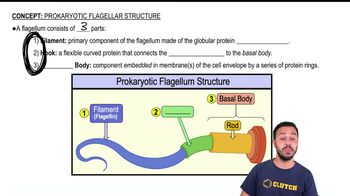
    Prokaryotic flagella consist of three main components: the filament, the hook, and the basal body, which anchors the flagellum to the cell envelope.
  • A bacterial cell exhibiting chemotaxis must have which structure?
    A bacterial cell exhibiting chemotaxis must have flagella to move toward or away from chemical signals.
  • What are the longer whip-like structures used for movement in prokaryotic cells called?
    The longer whip-like structures used for movement in prokaryotic cells are called flagella.
  • What protein is the filament of a prokaryotic flagellum primarily composed of?
    The filament is primarily composed of the globular protein flagellin.
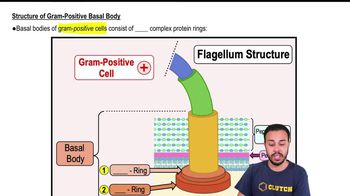
  • Which two protein rings are found in the basal body of both gram-positive and gram-negative bacterial flagella?
    The MS ring and the C ring are found in the basal body of both gram-positive and gram-negative bacterial flagella.
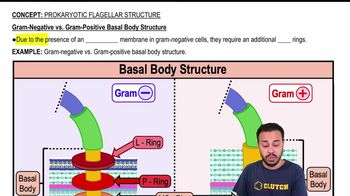
  • Where is the L ring located in the flagellar structure of gram-negative bacteria?
    The L ring is embedded in the outer membrane of gram-negative bacteria.
  • What is the main function of the hook in the prokaryotic flagellum?
    The hook is a flexible, curved protein that connects the filament to the basal body.
  • Why do gram-negative bacteria require additional protein rings in their flagellar basal body compared to gram-positive bacteria?
    Gram-negative bacteria have an extra outer membrane, necessitating the L and P rings for proper anchoring of the flagellum.