Skip to main content
Microbiology
My Course
Learn
Exam Prep
AI Tutor
Study Guides
Textbook Solutions
Flashcards
Explore
Try the app
My Course
Learn
Exam Prep
AI Tutor
Study Guides
Textbook Solutions
Flashcards
Explore
Try the app
Back
Prokaryotic Photosynthesis definitions
You can tap to flip the card.
Prokaryote
You can tap to flip the card.
👆
Prokaryote
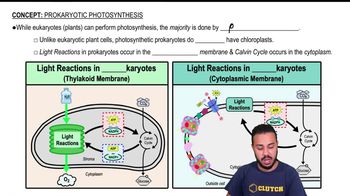
A cell type lacking membrane-bound organelles, where photosynthesis occurs in the plasma membrane and cytoplasm.
Track progress
Control buttons has been changed to "navigation" mode.
1/15
Related flashcards
Related practice
Recommended videos
Prokaryotic Photosynthesis quiz
Prokaryotic Photosynthesis
15 Terms
Prokaryotic Photosynthesis
13. Photosynthesis
5 problems
Topic
Brendan
Calvin Cycle
13. Photosynthesis
3 problems
Topic
Brendan
13. Photosynthesis
9 topics
13 problems
Chapter
Nicole
02:42
Prokaryotic Photosynthesis
1595
views
11
rank
05:23
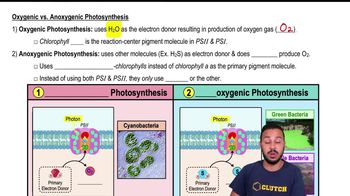
Oxygenic vs. Anoxygenic Photosynthesis
1559
views
11
rank
Terms in this set (15)
Hide definitions
Prokaryote
A cell type lacking membrane-bound organelles, where photosynthesis occurs in the plasma membrane and cytoplasm.
Chloroplast
A eukaryotic organelle containing thylakoids and stroma, serving as the site for photosynthesis in plants.
Plasma Membrane
A cellular boundary in prokaryotes where light reactions of photosynthesis take place.
Cytoplasm
The internal fluid of prokaryotic cells where the Calvin cycle occurs during photosynthesis.
Thylakoid Membrane
A structure within chloroplasts of eukaryotes where light reactions are localized.
Stroma
The fluid-filled space in chloroplasts where the Calvin cycle is carried out in eukaryotes.
Oxygenic Photosynthesis
A process using water as an electron donor, producing oxygen gas and involving both photosystem 1 and 2.
Anoxygenic Photosynthesis
A process using molecules other than water as electron donors, not producing oxygen and involving only one photosystem.
Photosystem 1
A protein complex involved in light reactions, present in both oxygenic and anoxygenic photosynthesis.
Photosystem 2
A protein complex required for splitting water and generating oxygen in oxygenic photosynthesis.
Chlorophyll a
The main pigment molecule in oxygenic photosynthesis, serving as the reaction center in both photosystems.
Bacteriochlorophyll
A pigment molecule used by anoxygenic photosynthetic organisms as the primary light-absorbing compound.
Electron Donor
A molecule, such as water or hydrogen sulfide, that provides electrons for the light reactions in photosynthesis.
Cyanobacteria
A group of prokaryotes performing oxygenic photosynthesis, using water and producing oxygen gas.
Calvin Cycle
A series of biochemical reactions converting carbon dioxide into organic compounds, occurring in the cytoplasm or stroma.
 BackBack
 02:42
02:42