Skip to main content
Microbiology
My Course
Learn
Exam Prep
AI Tutor
Study Guides
Textbook Solutions
Flashcards
Explore
Try the app
My Course
Learn
Exam Prep
AI Tutor
Study Guides
Textbook Solutions
Flashcards
Explore
Try the app
Back
Proteins definitions
You can tap to flip the card.
Protein
You can tap to flip the card.
👆
Protein
A functional biomolecule composed of one or more folded polypeptide chains, essential for cellular structure and function.
Track progress
Control buttons has been changed to "navigation" mode.
1/14
Related flashcards
Related practice
Recommended videos
Proteins quiz
Proteins
15 Terms
Proteins
5. Molecules of Microbiology
4 problems
Topic
Nicole
Nucleic Acids
5. Molecules of Microbiology
7 problems
Topic
Nicole
5. Molecules of Microbiology
8 topics
14 problems
Chapter
Nicole
08:02
Protein Structure
24967
views
334
rank
04:37
Amino Acids
25656
views
450
rank
02:50
Proteins
31214
views
594
rank
Terms in this set (14)
Hide definitions
Protein
A functional biomolecule composed of one or more folded polypeptide chains, essential for cellular structure and function.
Amino Acid
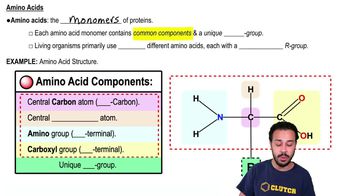
A monomeric unit with a central alpha carbon, amino group, carboxyl group, hydrogen, and a variable R group.
Peptide Bond
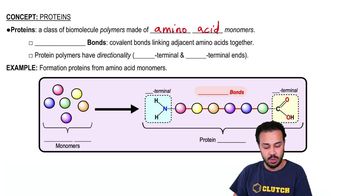
A covalent linkage joining adjacent amino acids in a chain, forming the backbone of protein polymers.
N-terminal
The end of a protein or polypeptide chain featuring a free amino group, marking the start of the sequence.
C-terminal
The end of a protein or polypeptide chain with a free carboxyl group, indicating the chain's conclusion.
R Group
A variable side chain attached to the alpha carbon of an amino acid, determining its unique properties.
Oligopeptide
A short chain consisting of 2 to 20 covalently linked amino acids.
Polypeptide
A linear chain of more than 50 amino acids, not necessarily in a functional folded state.
Primary Structure
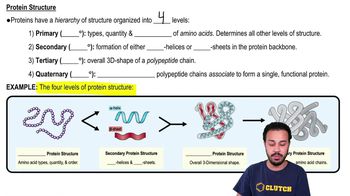
The specific sequence, type, and quantity of amino acids in a protein chain, dictating higher-level structures.
Secondary Structure
Local folding patterns in a protein backbone, such as alpha helices and beta sheets, stabilized by hydrogen bonds.
Tertiary Structure
The overall three-dimensional shape of a single polypeptide chain, resulting from interactions among side chains.
Quaternary Structure
The association of multiple polypeptide chains to form a single functional protein complex.
Denatured Protein
A nonfunctional form resulting from loss of native structure due to environmental changes like pH or temperature.
Chaperone Protein
A helper molecule that assists other proteins in regaining or maintaining their correct folded structure.
 BackBack
 08:02
08:02